Roseate Spoonbills on Big Slough

Roseate Spoonbills on Big Slough
Showing posts with label Anahuac NWR. Show all posts

Sunday, January 16, 2022

Visiting a Favorite Refuge with New Friends

 Our Volunteer Village has more than doubled in size with the arrival of two new volunteer couples. My free time schedule overlaps each of theirs by one day. Dee, Steve and I started talking about good birding places and I invited them to join me to visit Anahuac, the refuge where I volunteered while still working and the first refuge I volunteered at when I started my residential volunteer life. 

I further offered to give them the service I used to give people when I volunteered as a free birding guide for Birding Pals. I would bring lunch and guide them. Then we could enjoy a sunset supper at a restaurant on Bolivar Pennisula, along the intercoastal canal before catching the Galveston ferry. 

We had a wonderful day, but didn't even have time to visit all the parts of the main refuge, much less get to the Skillern Unit. But come along.....


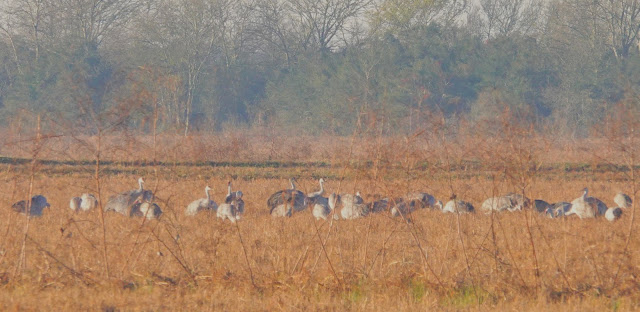
I was completely unable to refind the whooping crane, but we found a field with several groups of sandhill cranes


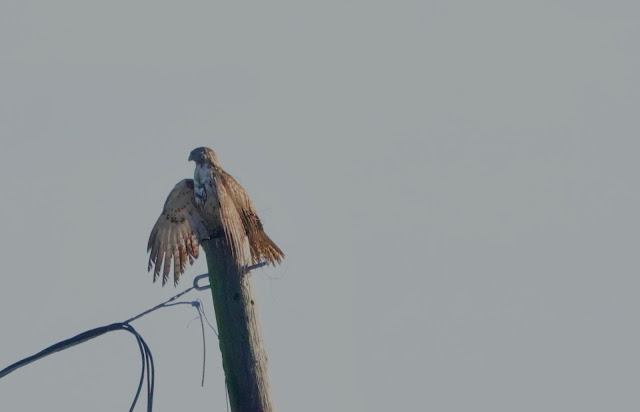
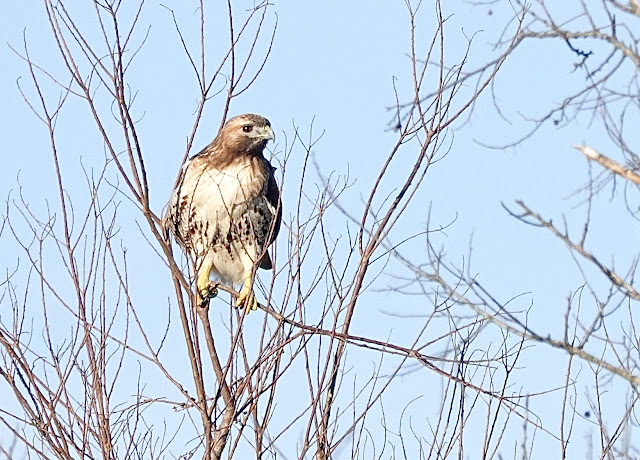
The first bird we photographed was this red-tail hawk warming himself in the early sunlight


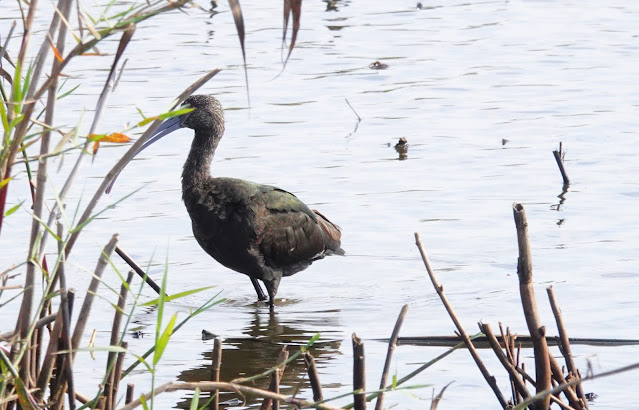
We started seeing lots of white-faced ibis as soon as we started around Shoveler Pond, the auto tour


Many species of birds were hunting together - the ibis' bill is backlit


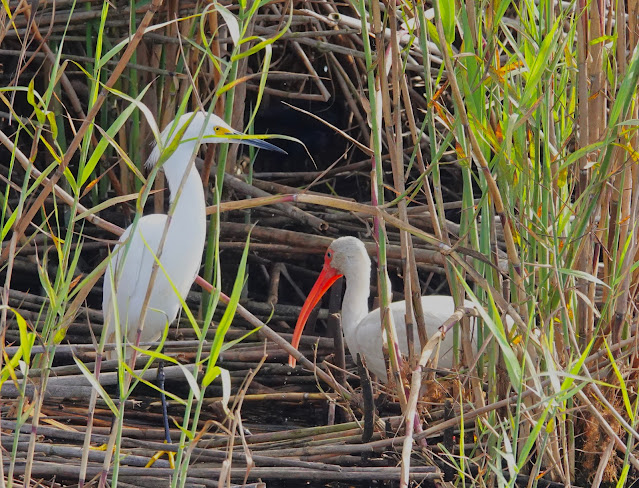
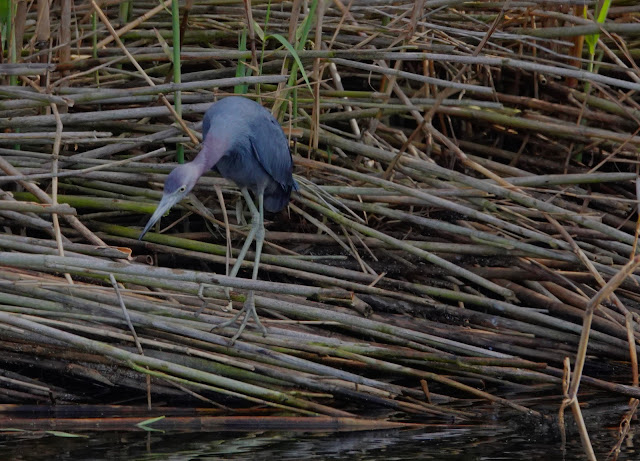
This little blue was with the above two birds, just a bit too far apart to make a good picture


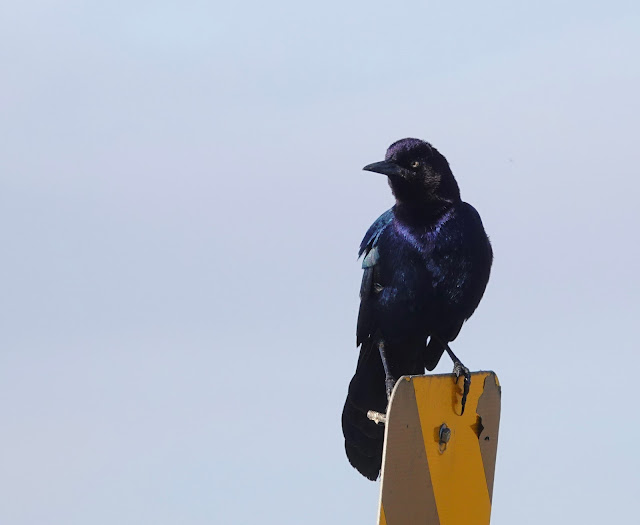
One of the birds people make a particular effort to find  here is the boat-tailed grackle. Dee and Steve could tell boat-tailed grackles from the more common great-tailed grackles with just a few looks. These birds are slightly smaller, have a MUCH rounder head, a smaller bill, and a blue iridescence


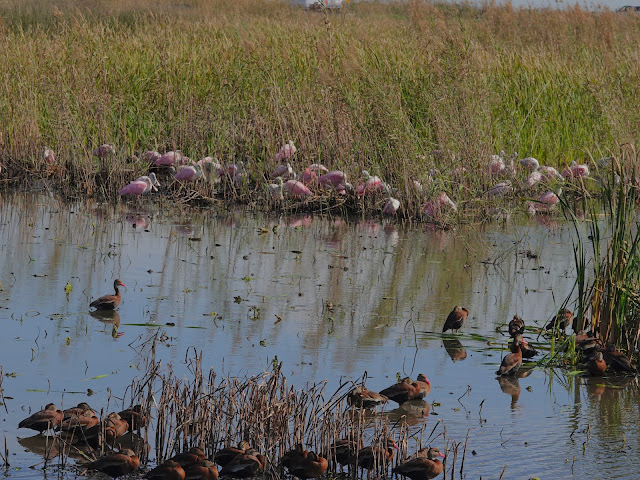
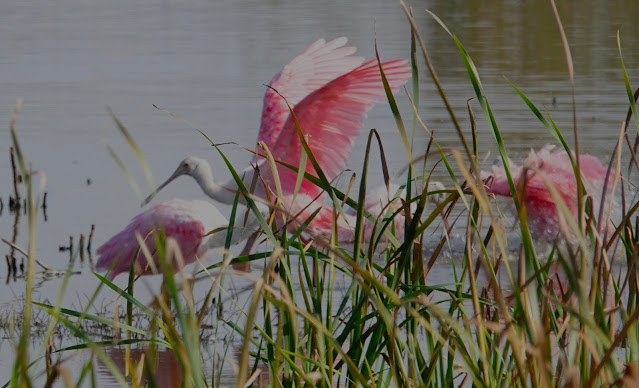
After coots and common gallinules, the two most common birds were black bellied whistling ducks and roseate spoonbills
 

It seemed some of the birds were starting early courting behavior. I'm not sure if this was courting or fighting


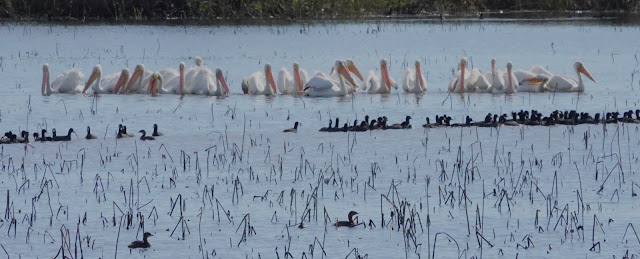
We spent another several delightful minutes watching these white pelicans cooperatively feeding


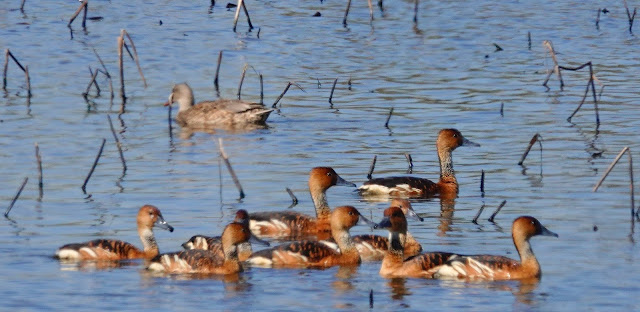
The birds I got most excited about were about a dozen fulvous whistling ducks.  I haven't seen any for over a dozen years.


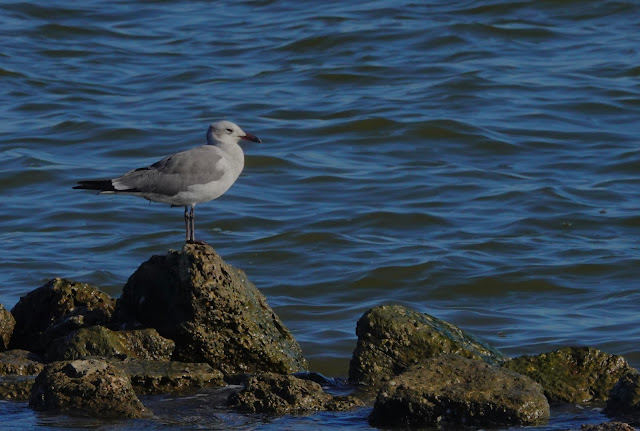
We made it all the way to the end of Frozen Point without seeing many birds, except for a
few hawks. But this laughing gull ...


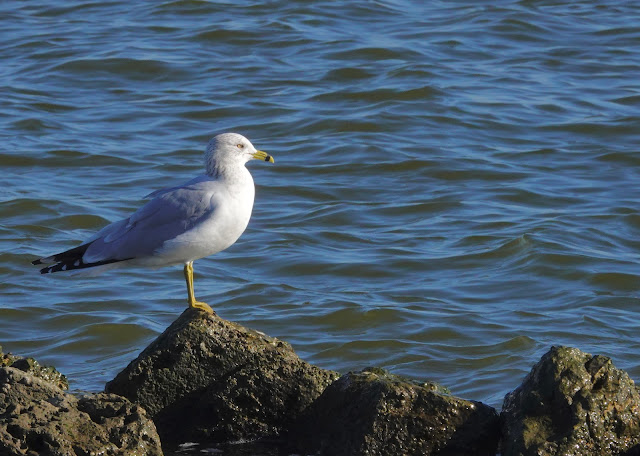
...was hanging out with a single ring-billed gull


We saw several red-tailed hawks but I liked this one's pugnacious expression best


The last time I visited here only a couple of weeks ago, I got to watch several large flocks
 of snow geese and greater 
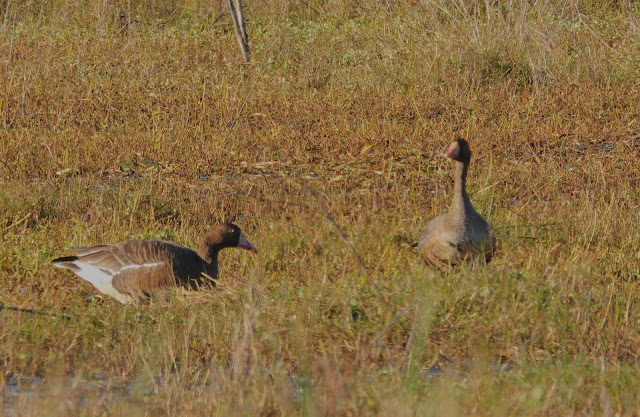
white-fronted geese fly over. This day, we only saw about
15 greater white-fronted geese on the ground 

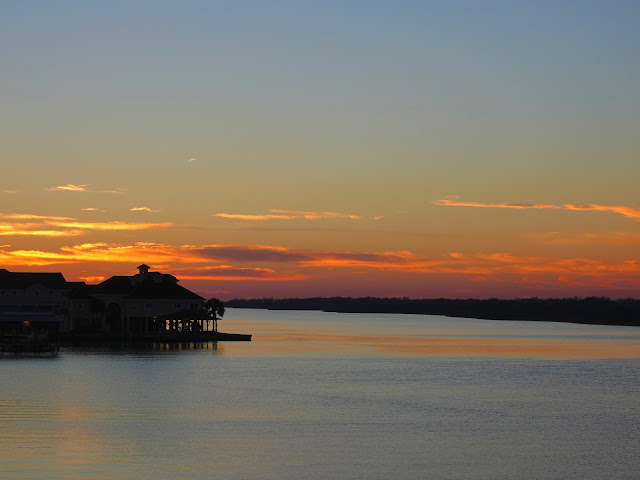
All too soon, and before we could even finish traveling all the roads at the main refuge, much less visit the Skillern unit and do some hiking, we realized, that to take the ferry home and get back about 8:00, we needed to start to the restaurant. When I was last here, Stingeree's, a restaurant that has ALWAYS been here, was closed. I found Steve's Landing which is also on the Intercoastal Canal and only a few miles east of Stingeree's. The food was outstanding, and I figured we could eat outside and enjoy the barges and other boats on the Intercoastal, as well as sunset.  Dee and Steve agreed and we had a lovely meal with  great entertainment.


This shrimp boat came to the marina next to the restaurant

The day was done and so were we


For my eBird list, click here: https://ebird.org/checklist/S100745702


Sunday, January 2, 2022

Chasing Birds

 On my last days off, I decided to wander where my spirit moved me and see how many birds I could photograph.  I first went south to San Bernard where there were few birds and none willing to come close enough for pictures. I was only able to get a eastern phoebe along the trails. The ponds only had common gallinules and American coots except for one alligator and two blue-winged teal.  The auto tour felt like Brazoria, with lots of coots, gallinules and blue-winged teal. The most activity was at the viewing platform, which had lots of herons, egrets, ibis, and teal. 


Eastern phoebe


The viewing platform was getting a lot of use

By late morning, I was starving, so set my GPS for On the River Restaurant in Freeport. The meal was delicious.  I checked out the Old Brazos River across the street, but only found a an osprey. Soon I was on my way to Galveston to catch the ferry. 


Osprey

That trip lasted much longer than I expected, as it took three ferries to get all people ahead of me across.  So I ended up crossing at sunset and not getting to bird Bolivar, North Jetty and all the other birding hot spots along the way.  I got excited about eating at Stingaree Restaurant only to find it was closed.  So I checked what other eateries were along the way.  I found a new-to-me Steve's Landing Restaurant.  It didn't have nearly enough wait people for the crowd, but the shrimp tacos were by far the best I've ever eaten. 


Sunset from the ferry


Sleep spot

My goal for the following day was to be at Anahuac National Wildlife Refuge at sunrise.  I slept at the rest stop in Chambers County where I enjoyed the lullaby provided by the eighteen wheelers. The sun and I arrived simultaneously at the entrance to Anahuac. I started off the day by watching huge flocks of geese fly out. I had fun driving around the auto tour, although there were fewer birds than I expected. 


Dawn sky filling with birds


A flock of white-faced ibis


A closer view of a white-faced ibis


One of a few visible alligators


A distant view of black necked stilts


A pair of caracaras


I finished up my Anahuac tour by going to frozen point, stopping to photograph the huge flock of black bellied whistling ducks. 


A fly up of black bellied whistling ducks


A pair of very tame neotropic cormorants


I also wanted to find to find the whooping crane that has been spending winters near Winnie, Texas. I used the coordinates provided by e-bird and found it in the same field where it was originally reported. After enjoying some time with it, I went after supper and another night at a rest stop. 


Whooping Crane


My next mission was to find the limpkin reported at Sheldon Lake Reservoir, so I got up in time to make the hour's drive in time for sunrise.  I was a few minutes late, but still got some pretty cloud pictures. I saw another birding couple and went to see what they knew.  We ended up looking for the limpkin for about an hour, while I shared my favorite birding places with them. After about an hour, we found not one, but two limpkins sitting in trees. We moved around to try to get a view that wasn't directly into the sun.  They sat around patiently for several minutes, before  disappearing into the swamp to feed on invasive apple snails.  We were joined by several other birders, including one that arrived after both birds had disappeared.


Sunrise was blocked by clouds leaving this view


The first limpkin flying off


While the second finished up its toilet


By this time, I was hungry and done with birding, so I continued on to spend a couple of days with Natalie and cook a New Year's Eve dinner before driving back to work New Year's Day, 

Happy New Year. Surely this will be the year COVID will become endemic.  Be safe.


Sunday, April 12, 2015

Where Have All the Migrants Gone?

It's migrant season here on the Texas Coast, with lots of passerines supposed to be migrating through our area.  But few migrating birds are being found.  I've been out to many Texas Hot Spots but have only found a few migrants. They are probably flying over us, but we are not even seeing many hummingbirds that usually hang out with us a few days.

I have a friend, Winnie, visiting Natalie and me.  We are all attending workshops and field trips at Galveston's Featherfest.  Winnie and I went off birding for a long day this past Wednesday, before the festival started.

I'm planning to paddle at Sheldon Lake State Park and Natalie decided to also list it as a Houston Canoe Club trip but wanted us to check out the water to be sure it was free of water hyacinths and giant salvenia.  This has a wading bird rookery on ten islands. It also has lots of other birds breeding there like purple gallinules, pie-billed grebes, and anhingas. But there is also a lot of habitat for warblers, buntings, tanagers, and other migrants, so we spent a few hours birding there without finding anything of note, not even a prothonotary warbler, which breeds here.

Winnie is also a Texas Master Naturalist, but was trained on different habitats than was I, since she lives in the drier area of the Central Texas Coast. I knew she would enjoy the restored pothole here. (This land had been a rice farm and a fish hatchery before it became a state park within Houston's city limits. The rice farmer had filled in the pothole to add to his rice-growing acreage. The park located an aerial photograph showing the location of the pothole, then did core studies to locate alien soils.  They removed that soil, and re-created the depression.  Then volunteers, including me several years ago, planted native grasses and forbs in it. )

Winnie reading the interpretive sign about the pothole. 

Spiderwort

A wetland forb and its pollinator

Crayfish must be very happy the pothole is back - their chimneys were everywhere. 

Pickerel weed serves as habitat to invertebrates that ducks love to eat

Black-bellied ducks among the pink primroses
We only saw a few birds but did get a long glimpse into an Anhinga rookery.  

We disturbed a yellow-crowned night heron

We finally got started back to our original plan of visiting Anahuac and High Island.  We stopped by the Office/Visitor Center that is just off Interstate Highway 10 because of the neat juxtaposition of an East Texas mixed forest, a cypress swamp and a reservoir/lake. There is one spot that usually has a breeding pair of prothonotary warblers but none were present. We didn't hear any birds but a white-eyed vireo and a Carolina wren.  We did enjoy a few turtles. 


We stopped to eat our picnic lunch at Double Bayou Park. My most notable birding day there was seeing a field full of perhaps 100 indigo buntings with a few painted buntings scattered about. Today, we saw a vulture the entire time we were eating and didn't hear any calls.

The day was growing late and we wanted to visit both boy scout woods, and Smith Woods at High Island so we skipped Old Anahuac and just stopped at Skillern. We found only a belted kingfisher along the bayou but did find a few birds, including a coot, blue-winged teal, northern shovelers, a couple of roseate spoonbills, one yellow-legs, one white-faced ibis, and one solitary sandpiper.  Again no warblers but the east trail along the bayou yielded a flock of about 20 white-crowned sparrows.

Then we went to Boy Scout Woods. I had to do a count there for eBird so I could count the sulfur-bellied flycatcher we saw there.  (The count was easy - 3 cardinals and one sulfur-bellied flycatcher) Winnie took this picture and it has garnered a lot of excitement among birders. We'll know tomorrow if the tour to High Island got to see it.

A very rare visitor here - sulfur-bellied flycatcher. 
We left Smith Woods for last.  We only walked around the lake, where I saw a
wood thrush and then only rookery birds. We spend about an hour at the rookery enjoying the birds.


Great egret in full breeding plumage, including green lores.  Many are on nests.

Most roseate spoonbills are only hanging out but a couple were nesting. 

Winnie spotted this alligator up in the trees in the rookery he'll eat well when older siblings kick younger ones out of the nests

Little blue herons are just beginning to appear

Strange companions

Tri-colored herons are also beginning to show up - think more of them are on the back part of the island
We left with enough light left to go look for the little and Bonaparte's gulls that had been hanging around together. But there was a lot of human activity on the beach and we saw no sign of them. But we did see the common visitors, - laughing gulls, sanderlings, ruddy turnstones, and willets.


A very handsome willett

Then we stopped by a very popular restaurant that is right on the ship channel and were there when the sun almost came out of the clouds and gave us this view.  We went to take this picture - and lots more, of course - between our salad and entree course. We came back to find our table cleared and new people being seated there. But we soon got new drinks and our entrees.


Returning fishermen
Winnie and I had a good day, even with limited numbers of birds to see and photograph. And we got an unexpected lifer.

I'm going to be blogging sporadically from now to mid-May.  I'll be camping and visiting friends, paddling, and birding and then rushing to leave for Montana. I should finish my migration May 11 and be on my summer grounds, Red Rock Lake National Wildlife Refuge.