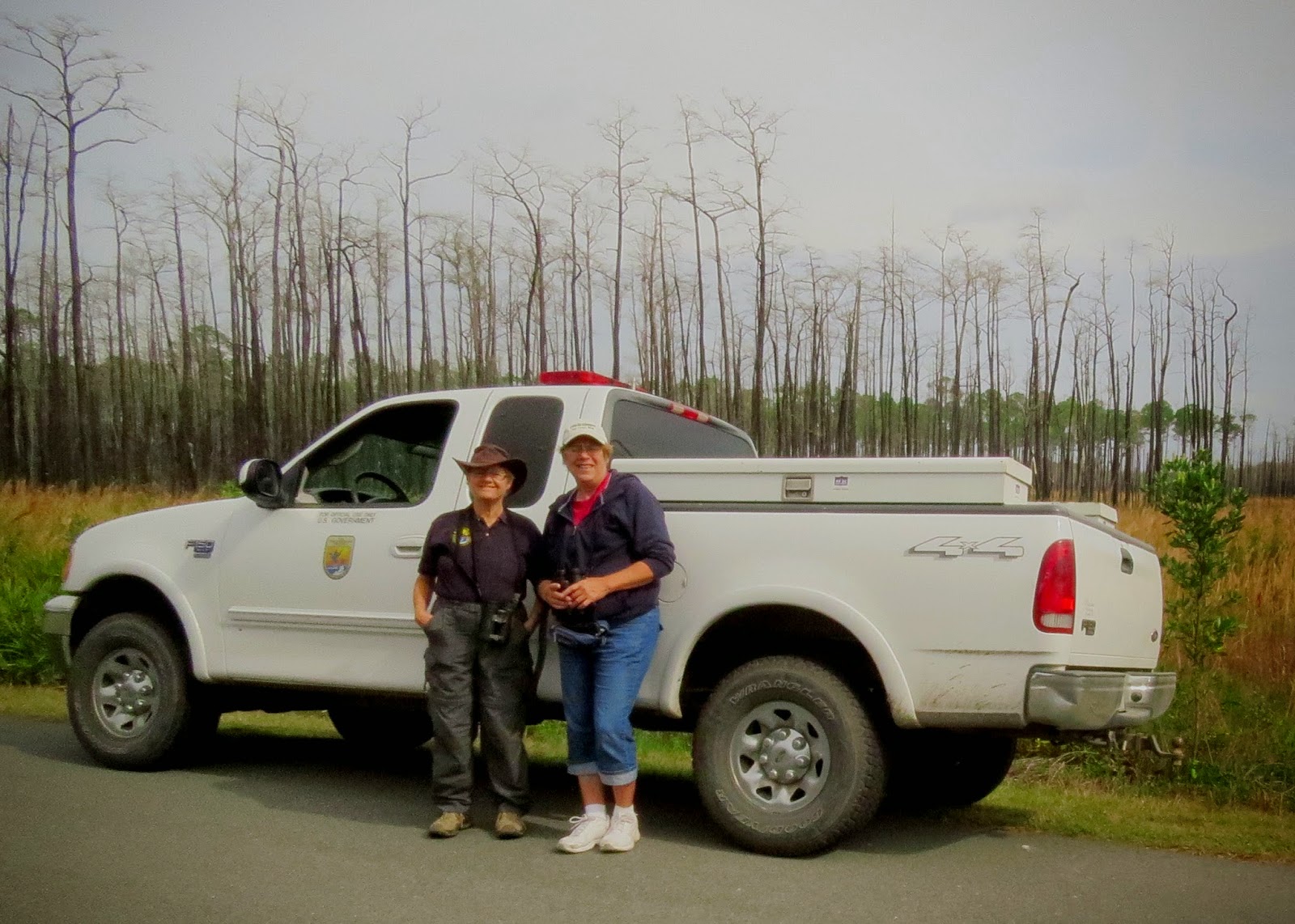
If I have an assignment to rove or lead a tour , I have a hard time remembering to stop working. Mostly, I feel like I'm playing and gathering up new friends as I move around, or as I get involved in interesting conversations. And before and after my scheduled work hours, or on my days off, I'm doing the same thing. So the only way to tell if I'm working, is to check my shirt. If I'm in my official shirt, I must have had to work eight hours during that day.
 |
| The red maple seeds look especially beautiful against the Spanish moss |
 |
| These plants have been blooming a few weeks |
Right now the refuge is changing each day. New trees are leafing out, and new wildflowers and blooming shrubs are appearing. I need to find all this new vegetation and then help visitors find it. Winter avian visitors are leaving while migrants are stopping by. Gotta keep tabs. Resident birds are nesting or raising young. I even saw a pair of fledgling owls on my last boat tour. (It is also part of my duty to take frequent boat tours so I can advise visitors of what they will see by boat - and I can't wear my shirt, so you'll have to take my word for it - It's WORK.)
 |
| One of the palm warblers that were still here early this week |
 |
| On one of the tour boats reaching Chesser's prairie |
 |
| I worked hard to get this sunset from the sunset tour boat |
This past week, I went out with another volunteer to rove. We assigned ourselves the task of finding every blooming species of plant, picking the best sites for each species and then learning the location so we can describe both the flower, and the area in which to find it.
 |
| Willow blooms - pollinators love them |
 |
| Volunteer Barb and I found several Osceola's Plume, Zigadenus dengus |
 |
| Osceola's Plume Close Up |
 |
| Orange milkwort, Polygala lutea - one local name is Swamp cheetos |
 |
| Barb found these newly emerged Pink Sundew, Drosera capillaris, but now I can locate them too |
On another work day, as I was getting ready to count birds on the Cane Pole Trail, I met a visitor I've met a few times before - she and her husband are wintering her and come by often. She was interested in both birds and plants. We started off by counting all the bird species we could find on the Cane Pole Trail. She was able to get some gorgeous pictures of a Prairie Warbler. That just may be the most cooperative warbler we have. It forages low and slow so you get lots of clear looks at it. We didn't find a Palm warblers but I had found them while "working" a day or so earlier.
 |
| Palm warblers are heading north |
 |
| Mary was kind enough to send me a picture of the prairie warbler we found. Thanks Mary |
After that we went on down the auto tour, stopping to look at all the flowers I'd discovered and also looking for the just-up sundews. We ended up spending about three hours together and found six parrot pitcher plants trying to regrow, two with flower buds on them. Then we had her husband take our picture on both our cameras.
 |
| Me with my new friend, Mary, after finding six parrot pitcher plants, Note the shirt, and the truck - a sure sign I'm working. |
I also had to wander around the boardwalk by myself, between visitors, but got to enjoy our blonde raccoon that forages near the beginning of the boardwalk. It is being seen often enough that we tell early and late visitors to watch for it. On one day, I spent about ten minutes taking pictures of it.
 |
| Blonde racoon foraging |
I also find lots of puzzling things. One of them appeared to be a bundle of male longleaf pine cones. If you know what this is all about, please share.
 |
| Mysterious bundle |
Friday I grabbed my clothes out of the dryer in the community trailer during my lunch break and then noticed some big greenish-white blooms nearby. They were pawpaw blooms. So I went around looking for more as part of my afternoon job.
 |
Pawpaw plants among the saw palmetto
|
 |
| They just get prettier, the closer I got to them |
 |
| Intricate blooms start off green and then turn white |
Saturday, I was supposed to lead a boardwalk tour but no one showed up. I just roved down the boardwalk, and was able to share alligators, turtles, birds and the first magnolia bloom with visitors, including a German couple. Earlier, I also found a red-shouldered hawk nest that is just past the canoe launch site. The nest is mostly invisible but I watched the male red-tailed hawk come screaming in with a large lizard. Then I heard the female talking to the babies.
 |
| One of the pig frogs I help visitors find and identify |
Another way I can tell if I'm working or not is by the sunset. If I'm looking at one, I'm NOT working because the refuge closes before sunset and I have no work to do. (At least that's true unless I'm on the sunset tour boat.)
 |
| Relaxing after yet another hard days work |
On the personal front, I'm down to just two more adventures and 8 days of work before I'll be packing and leaving April 15. Tomorrow I'm off to paddle the Altamaha River for two days with Julie DeVore who was my
guest blogger recently. This will be our first real meeting but I feel I know her well after lots of chats via e-mail and phone. Next weekend, I'm going to visit another new friend that I met while WORKING here. We'll be paddling and birding ..... stay tuned for the details. Probably lots of hard play will be involved.