Roseate Spoonbills on Big Slough

Roseate Spoonbills on Big Slough
Showing posts with label Malheur National Wildlife Refuge. Show all posts

Monday, October 29, 2012

Steen Mountain, Closed for the Winter


I really wanted to show Lucy Steen Mountain.  I tried to get her to go by herself but she was busy looking at stuff closer.  Then on my first weekend with her, we went to John Day Fossil Day Fossil Beds.  The next week, she took my car and drove off to see some of western Oregon and visit her cousin who lives in Corvalis, OR.  Then, right after she got back, it snowed, about a half inch one day, and four inches the next. Since the top of Steen is at almost 10,000 feet, I was pretty sure we were not going to make it to the top.  

We stopped at Buena Vista to check out the view.  All the ponds are gone and there are only a few sparrows around. 


View to Steen Mountain From Buena Vista Overlook

A Closer Look at First Snow of Fall on Steen Mountain

 We did a quick stop at P-Ranch to see the long barn and other structures and to take a short walk along Blitzen River. It is the most beautiful along this stretch where it has been improved to a better spawning area for fish.


The cattle wheel, used to hang cattle to butcher

This lifted loose hay on and off the hay wagon
The long barn

Hand made hinges

Lucy walking where the horses roamed

Blitzen River
 But I was really surprised to find snow on the Steen Loop Road at 5000 feet.  We turned around, before seeing much of anything, and went back through Frenchglen and then tried the southern end of the loop.  This time we barely got past the gate to the upper portion before we had to turn around. We did get pretty close to one of the gorges and got to see a few wild horses.


One of several gorges on Steen Mountain

A few wild horses
We had planned to explore Riddle Ranch but found the gate was closed and we would have to hike six miles round trip on a muddy road.  We decided we didn't have enough time or inclination for that long of a hike. 

On the work front, I’ve finished my part of the bee display.  I have several different wildflowers that I dried, then arranged.  Then I glued some bees and butterflies I’d collected on the flowers. And Carla, the staff member who does most of the displays here, has almost finished the posters.  For some of them, she is using my pictures and adding facts I’ve researched about the flowers I dried and also the bees found here. She is going to give me the files for all the posters so I can share them with others. I’ll put up a post of them that will come out after I’ve gone. 

I started writing this over the weekend but we were without Internet until today, Monday afternoon. The staff gave me a going away luncheon and both a sweat shirt and a jacket with the Volunteer logo on them. Then I took back all the materials that belonged somewhere else, build a rack to carry three bags on top of the car, finished packing and cleaned the house up, all with Lucy's help.  We cleaned out our refrigerator and gave almost two coolers of food, staples, and condiments to the two interns. 

Tomorrow,  starting about 5:00 A.M.  we are going to Boise,  Idaho for a little shopping and to get my car checked. I’m afraid my starter may be going out since the car will barely start some mornings, but the battery checks out fine. Then we’ll sleep – if the car gets fixed – near Crater of the Moon National Park. We’ll spend two nights and a day there before going to Bryce NP, then Zion NP, Santa Fe, a state park in North Texas, and before arriving  in Houston on November seventh or eighth. 

I’ll probably not have time to edit pictures or put up any blogs until I get to Galveston where I’ll be pet-sitting at my friend, Natalie’s house. I think she has some painting jobs waiting for me as well.  But I’ll catch you up on my adventures after November 10. 


Sunday, October 21, 2012

Leaving the Gold


A few days ago, we had at least four kinds of weather before noon.  One of them was a clearing sky with a beautiful rainbow  about15 minutes before clouds returned and we had a couple of minutes of light rain.

Rainbow over Malheur Lake
I raced out to get the picture of the rainbow showing the gold in Malheur Lake and then went on to work.  Later I had to go back to my house to get some of the things I'd left behind in the rush.  But I started thinking about the promise of the rainbow and how I had really gotten the gold ring when I was accepted to work here. I had some of the most enjoyable jobs I've ever done, including designing activities on pollinators and then sharing them with the Paiute Indian kids, producing a Power Point show that introduces the refuge, and working many hours on collecting bees, pinning bees, and working on a bee display. And I have made golden friendships here and hope to work with some of the volunteers here or at other refuges.

Shades of gold have been one of the main colors here in the desert.  Now, even the wetland grasses are golden. Some of the trees are also turning golden. And the wildlife is golden too, in the sense of  riches.

Here is a retrospect of my favorite pictures of the golden place. .  Many of them have golden colors and the rest represent the riches of Malheur. 

Our famous cottonwood tree on Central Patrol Road

The oh-so-entertaining Chicogoans, AKA California quail.

The first bumblebee I met up here

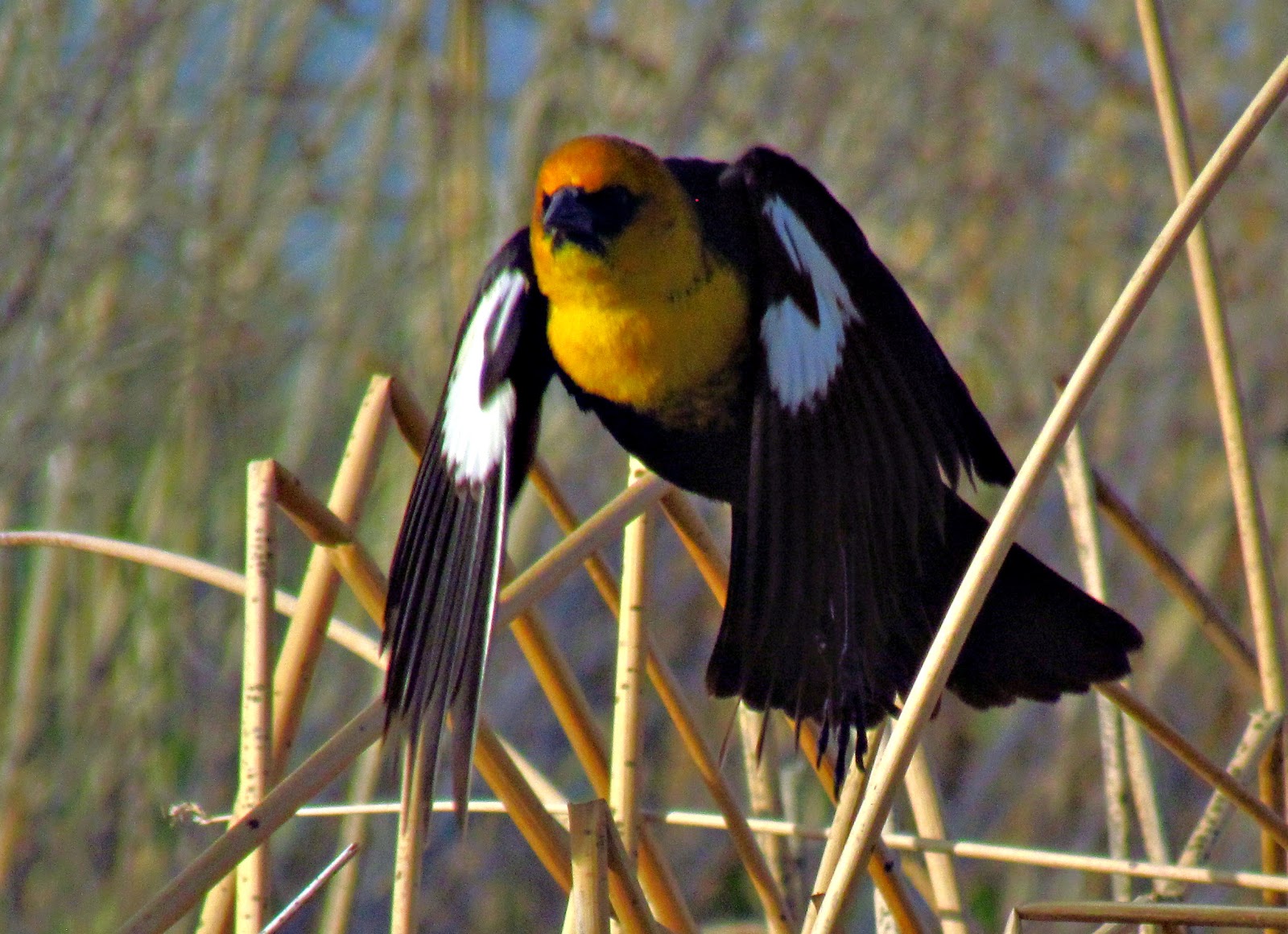
One of thousands of yellow-headed blackbirds that came to breed here

Monkey flower showing its nectar guides - the red spots.

Willow blooms- for feasting bees, flies, and beetles

Black-headed grosbeak getting grape jelly snack

Singing bobolink

Headquarters fawns on one of their first  forays away from Mom

Black-crowned night heron.I woke him up and he's a little indignant

Hungry deer eating from my willow tree

One of our breeding sandhill crane pairs

There is also dross here. Malheur Lake has been so degraded by  invasive carp that it can only support  about ten percent of the historic numbers of waterfowl and waders. I came back from my vacations to find almost no water or birds in the wet fields.. And there are very few birds on Malheur and Mud lakes. But the good news is that the refuge is working with other partners to learn ways to control the carp in all of Harney Basin and there is lots of research going on to determine all the ways they can get the upper hand with the carp. I'm hoping that our pot of gold will be carp numbers greatly reduced and maintained, the turbidity in the lake cleared up, and food needed by  the ducks, geese, swans and native fish once more able to get enough light to grow. This will make this place a golden  stopover for birds in the fall, as well as in the spring.


https://blogger.googleusercontent.com/img/b/R29vZ2xl/AVvXsEjMLhyzrCnzHbGWpRcRLwUCaLviakN-PruMUWUkeGa0nhOiaLWnfwxY8P8oMonznfLOe80UKAd4MQfNFtD-NvW9QK7Hhqv7m1XEi5obukB2JaLjXDeLjziDB3Zp56TXCvWMcUiu0AvsTLo/s400/12042202Sunset+over+Malheur.jpg


I'm leaving all this gold in a on October 30.  It's always a bittersweet time, looking back at what I'm leaving and looking forward to visiting friends and relatives while waiting to confirm my next assignment. And Lucy is going to ride with me to share adventures and costs so that will be fun.


Saturday, July 28, 2012

Hectic Times

I'm finding it hard to believe that I'll be leaving Malheur National Wildlife Refuge August 7 or 8. And I don't see how I can get all my projects finished. I'm still drying flowers and need to catch and mount butterflies and more bees for my pollinator display. And I have to put together another hour's worth of activities for the Indian kids. And I have at least twenty to thirty hours of pinning bees left to do. I'm even further behind because I spent four days barely able to walk and with a swollen, painful knee. But I'm seeing a chiropractor and am most of the the way better. 

So the blog has had to go to the back burner.  Then, while I'm traveling and playing, in August and September,  I won't have much Internet access so the blogs will be pretty spotty until October, when I return here for a final month.

The hummers are migrating and we are getting lots of them around -rufus and black-chinned

Right now, things are really quiet. Baby birds and mammals are spending more time away from their parents. Many birds have disappeared as the area gets dryer and dryer. The twin fawns are starting to graze and play away from their mother while the bucks are growing their velvet covered antlers. The days are bring and the colors of the vegetation is fading. Most of the wildflowers are finished blooming and it seems that all of nature has swung almost through summer and is pausing  before starting its swing back into fall.

Twin fawns eating their bedtime snack
One of the staff members told me that October is his favorite month and that the vegetation colors will brighten up again, while the birds begin to stop here to fuel up for flights further south.  Indeed, the fall migration of the hummers has already started and I had to put up two feeders which almost have hummers and the resident Bullock oriole family.The red-winged and yellow-headed blackbirds are starting to form flocks as our our tree, barn, and cliff swallows. We have to slow down coming across the bridges on Sodhouse Lane to avoid hitting them since they love to sit on the pavement.

One of my assignments was to take Jo, the new volunteer, on a tour of the refuge.  That has taken part of three days but we finished it this morning. We saw the most ducks on Buena Vista Pond that we have seen in a while. And we got to enjoy a raccoon who was still out fishing about eight o'clock this morning.

Deer on the Upper Central Patrol Road

A raccoon was still fishing on the Blitzen River
Smartweed, an important duck food, in the morning light
 I haven't been able to post my pictures to this blog for three days. Finally I tried to post my pictures to Picassa and then import them to the blog from there.   It seems the more I have to do, the harder it is to get it done. 

Back to the third batch of bees I've done today.  I'm pinning them while watching the Olympics. 


Wednesday, June 13, 2012

Kids Rule

All refuges offer an educational component that may include visits to classrooms, a reading contest where children read books about nature, special events with educational activities, and field trips for classes where part of the time spent on the refuge is spent doing active learning.

Staffer Kris with his first group, getting ready to learn about the fish at Malheur
 We sponsored a field trip day last Monday for the two third grade classes from an elementary school in Burns, Oregon.   I didn't get to find out much about what the other volunteers and staff were doing, but we had four stations and the kids spend thirty minutes at each station.  So each volunteer or staff person presented the same activity four times. These  field trips are a lot of fun for the kids and I love helping with them.
My current volunteer housemate, Teri, visits with a student while waiting to collect her first class
The kids received field journals with a couple of pages devoted to each activity
At my station, the kids learned about different bird beaks and feet.  We talked about what a bird looks like and about different beak types. Then they got to go into the George Benson Memorial Museum and search for birds that eat different kinds of food, seeds, mammals, insects, etc. While they were in the museum, they also drew a bird, in their journals, paying special attention to it's beak and feet.

"Birds" collecting food with their "beaks"
The kids really got into this activity.
Then they came back out to the picnic tables and became birds. They all used their "beaks" - tweezers, clothespins, spoons, or scissors- to pick up various "foods".  Finally we counted up all the foods they were able to get with their beaks and discussed which beaks were best suited to each food.
 
The final part of the day was a tree planting to commemorate the day and to give the kids another incentive to come back.

The tree was a tiny cottonwood started from a cutting last year
The kids, their teachers, parent aids, and the instructors all had a wonderful time and hopefully all of us learned something about the environment and our role in protecting our native plants and animals.


Saturday, June 9, 2012

The Giving Tree

One of the hardest things for me to do without are trees.  I think I still have genetic memories of living in a tree, and while I love looking at prairies and deserts, I just don't feel as secure as I when I'm in a  nice stand of trees.

Here at Coyote House, in Malheur NWR, we only have one tree in our yard, a really beat-up willow that is over half dead. (Actually is is four stems in one hole which functions as a single tree.) But it is the most interesting  thing to watch from the picture window of our living room, the site of the desk where I spend a lot of time reading and writing off my computer and also pinning bees, because it offers  food and shelter to so much wildlife and constant entertainment to the residents of Coyote Hollow. 

As I'm writing, a deer just jumped over our front fence to stretch up for a snack of willow leaves. Two or three black-chinned hummers spend a lot of time visiting two hummingbird feeders in the tree. . The female Bullock's oriole just came by for a bite of grape jelly.  The Niger seed feeder used to feed lesser and American goldfinches. Then  I got so many red-winged and yellow-headed blackbirds that I tried to cut the perches WAY back to prevent them from hogging all the seed.  Now only the most agile and athletic yellow-headed blackbirds can use them, which have to flutter in place to get the seeds. Very entertaining. The red-winged blackbirds can still fit on the perches so shortening them didn't really work.

I think I can reach those leaves.

Yum!
 A western kingbird often uses it as a perch, while Bullock's orioles and western tanagers come regularly to eat oranges and grape jelly. California quail come to eat seeds under it and the lookout quail is often seen sitting up in the tree. I saw my first black-headed grosbeak sitting on the grape jelly feeder.The Bullock orioles, first seen here,  also were lifers. Yellow warblers stop by to forage for bugs.  And yellow-rumped warblers sometimes are found using the tree for a perch from which to sally out after flying insects. Red-winged blackbirds, yellow-headed blackbirds, Brewer's blackbirds, and brown-headed cowbirds are often found resting here in single or mixed flocks. Yellow-billed magpie's come to check the suet feeder and eat the peanut-butter mix if it's out there. One just came and sampled an orange. The second eastern kingbird I've seen in the region flew in here a few days ago. Hopefully the birds can also catch the bugs attracted to the sugar and jelly.


"Can't you see we need more grape jelly!" says the western tanager
 I found I could train Belding's ground squirrels to climb the tree to eat the peanut butter/lard mix I make and spread into the bark. And one of then learned how to reach an orange that I had on a stub close to the trunk and ate most of that half.

Bellding's ground squirrels will eat the seeds that fall to the ground and climb for oranges and peanut butter mix
 A western kingbird often uses it as a perch while Bullock's orioles and western tanagers come regularly to eat oranges and grape jelly. California quail come to eat seeds under it and the lookout quail is often seen sitting up in the tree. I saw my first black-headed grosbeak sitting on the  grape jelly feeder and also the Bullock orioles were lifers. Yellow warblers stop by to forage for bugs.  And yellow-rumped warblers sometimes are found in this tree, hawking insects.  Red-winged blackbirds, yellow-headed blackbirds, Brewer's blackbirds, and brown-headed cowbirds are often found here in single or mixed flocks. Magpie's come to check the suet feeder and eat the peanut-butter mix if it's out there.

Black-headed grossbeak on jelly feeder - a recycled butter tub
Black-chinned hummers are the first and last feeders here
 I'm hoping to get more trees started in this yard, but I understand that, because there is an  archeological  site below the houses, there was a gravelly fill put in before the houses were moved here and there is too  much drainage to get trees to grow. I'm going to see if I can get them to grow in a little depression, hopefully with a little excavation  and an addition of water holding materials.

In this mostly treeless area, trees are super magnets for birds and social gatherings for the resident volunteers. If you have room in your yard, plant a local species of willow.  They are huge bird magnets and also feed the pollinators early in the spring. They attract a lot of insects that bring in the passerines during migration. And many species of birds will build nests in them.

Tuesday, June 5, 2012

Wildflowers at Krumbo Reservoir, Malheur National Wildlife Refuge

As part of my bee study, I'm also trying to document all the wildflowers that are blooming near the places I trap bees. And I'm trying to get pictures of bees and butterflies on wildflowers.

The hardest part is finding out their names. I've spent a couple of hours today trying to find out the name of an Erigeron and think I'll have to go get more pictures of it to finally get to the species.

Here are the plants I found on the hillside above Krumbo Reservoir May 22, 2012.


Tidytips  Layia glandulosa

Desert paintbrush  (Castilleja chromosa)

             Basalt milkvetch  (Astragalus filipes)

Yellow Desert Paintbrush (Castilleja chromosa)

A fern I haven't identified growing on a rocky hill
 I learned that one often has to see the seeds of this genus to get to the species.That is true for this genus.
Microseris sp

Arrowleaf Balsamroot  (Balsamorhiza sagittata)

The biologist didn't know this flower.  It is currently under discussion in the Oregon Native Plant Society list.  I'm going to get better close-up pictures.  The name is correct to genus but maybe not to species.


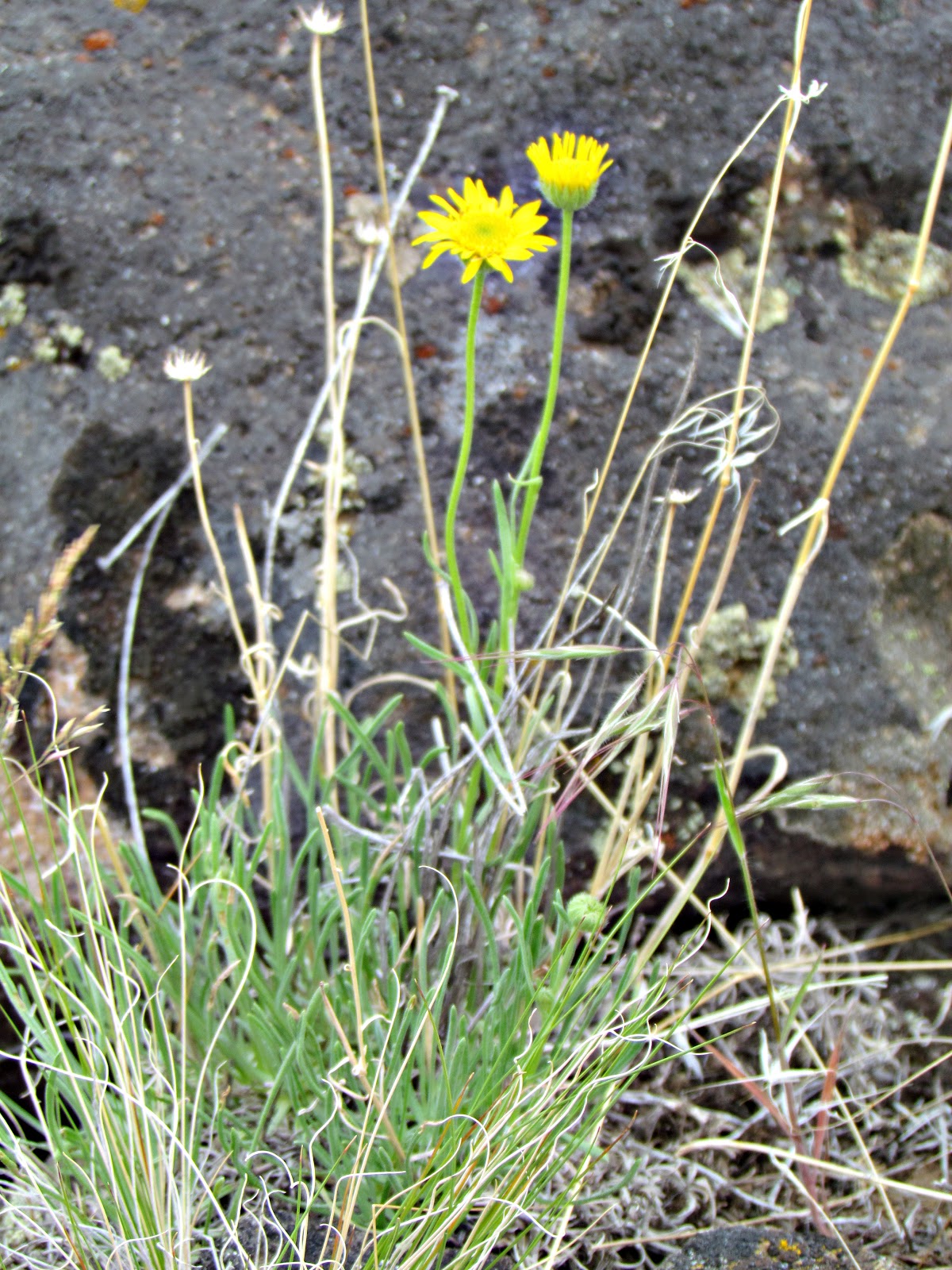
Yellow desert fleabane (Erigeron linearis?)

I think this plant is probably the desert fleabane. But I'd love feedback on this plant as well.
This is much more common and grows in small to medium patches.  I think these are two different plant with the first one having succulent leaves.  


Yellow desert daisy (Erigeron linearis?)

Common Larkspur Delphinium nuttallianum

Stemless mock goldenweed,Stenotus acaul

Spiny phlox, Phlox hoodii


Spring is in definitely heating up.  But I'll be able to find spring flowers all summer by driving about 50 miles to the upper parts of Steen Mountain. And  I'm looking forward to learning all the plants that grow at Malheur NWR.