Roseate Spoonbills on Big Slough

Roseate Spoonbills on Big Slough
Showing posts with label Birding Central Texas Coast. Show all posts

Wednesday, November 9, 2016

Tormented by Butterflies


November 4, 2016


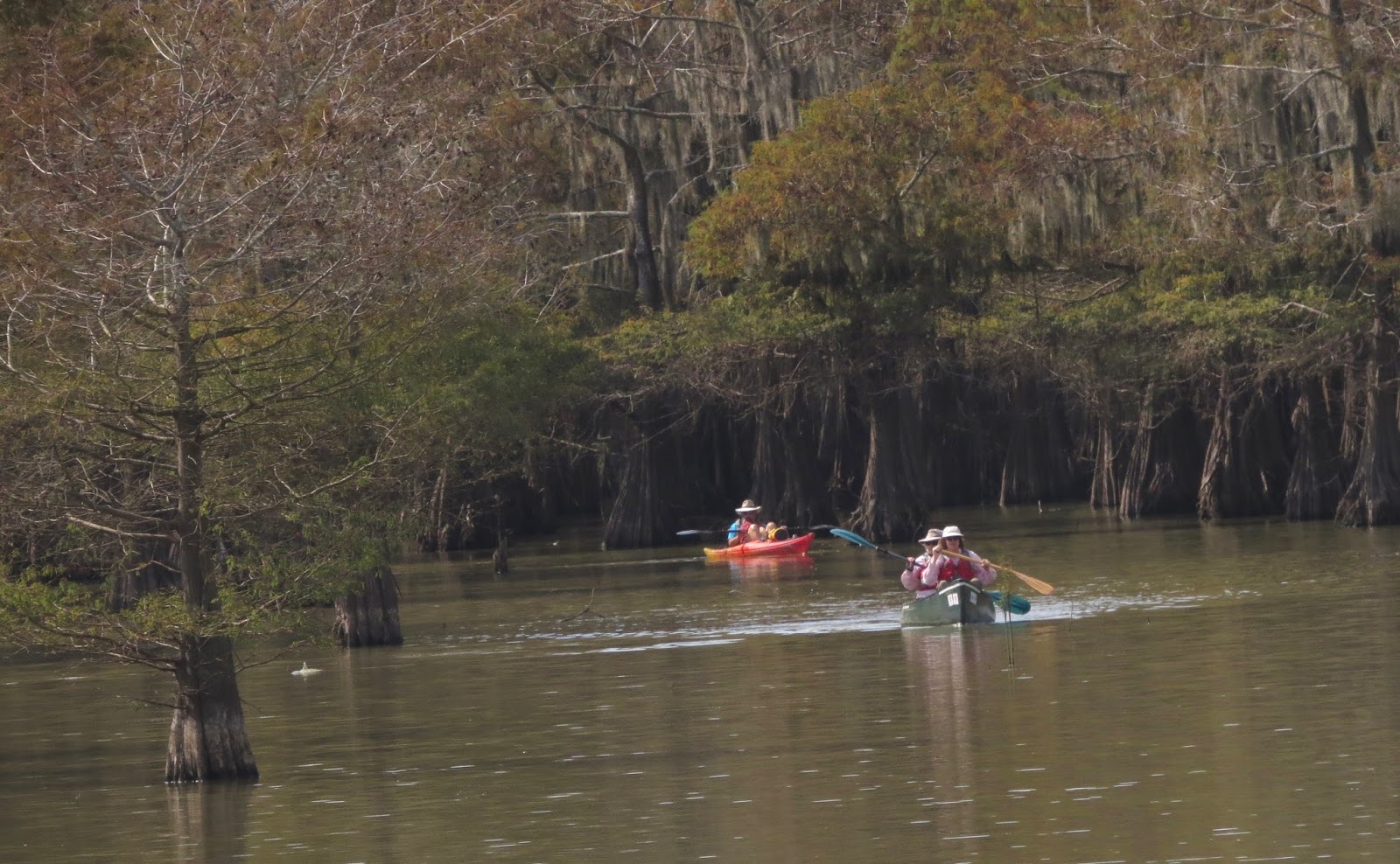
Paddling buddy, Dave invited us to go paddle at Champion Lake, another of my favorite swampy places in Trinity River NWR.  He even offered to paddle both me and Ellen in Natalie's tandem canoe, while Natalie paddled his kayak.  I declined because I'd rather hike then sit and I have spent many happy hours on land there.

I immediately started checking out all the distant birds by taking pictures and then blowing them up in the camera.  A pair of white dots in a distant tree turned into wood storks, a most coveted species in the late summer and fall, when Mexican juveniles sneak across the border and wander along the Texas coast.


Natalie and Ellen enjoying the put-in views

A long view of a pair of wood storks

After the paddlers left, I started walking the mowed path on the levy that forms the lake.  It goes all the way to the Trinity River but I got ambushed by thousands of butterflies and only managed about a half mile of it.  Every step caused twenty to forty butterflies to jump out of the grasses and forbs. The sun was bright and the air was warm. so the butterflies quickly flew out of camera range, while others caught my eye.  Most of the butterflies were less than an inch across their wings so I couldn't even see them on my camera screen. I spent a lot of time trying to capture them, getting ever more frustrated until the sun got too bright for pictures. Then I just enjoyed their bright movement while listening to the hum of honeybees and syrphid flies.


Queens were the most abundant and cooperative 

But only occasionally showed me their monarch-like undersides 

Migrating monarchs were resting in grass.....

Or among willow leaves.....

Or feeding on the abundant fleabane

The waterway narrowed along the trail and I was able to ambush
this pair of white ibis feeding on the far side

Metalmark species?


Think a different species of metalmark

I also checked out a side trail that went through wet woods full of little, mostly dry sloughs.  Finally I turned back so I wouldn't make the paddlers have to wait on me,  I had time to compile my bird list and then add a pair of roseate spoonbills before I caught sight of the returning paddlers.


One of the very few signs of fall

This little slough had enough water to make pretty reflections

There were lots of palmettos,  one of my favorite plants


This comma sat quickly on a tree trunk

There were cloudless, and I think, dogface sulfurs but most were too fast to capture -
this cloudless was in the butterfly garden


The last bloom of marsh mallow - it was across the lake from me


Great blue herons are hard to see against the trees


Returning paddlers


A pair of roseate spoonbills were the last birds on my checklist


Their flight starts with free fall


By the time we were ready to leave - around 2:00 PM, we were starving and had to make a stop for hamburgers. Another beautiful day.

I'm linking up to Wild Bird Wednesday.  Click on the picture to see bird blogs from around the world.


Wednesday, October 21, 2015

Migration- A Lost Art?

October 13, 2015

After visiting my friends in Corpus Christi, Winnie and I drove to Port Aransas, a marvelous coastal birding town. It has several places that are the Central Texas Coast Birding Trail, Mustang Island Loop,  and which, during winter and especially spring, are fantastic places to find both migrating and local birds.

We expected to find shore birds plus various passerines migrating, but only saw a few possible migrants, mixed in with even fewer local birds.  The only warbler's we saw were common yellowthroat, which also breed in the area. We did see Lincoln's sparrows, Savannah sparrows, and a couple of Lark sparrows. We also found on early shrike. The shorebirds consisted mostly of greater and lesser yellowlegs, black-necked stilts, and a few least sandpipers, as well as a couple of dunlin. We birded at Charlie's Pasture, known on the Great Texas Birding Trails as Port Aransas Wetland Park, at the wastewater plant, now called the Leonabelle Turnbull Birding Center. and Paradise Pond - currently looking very damaged, both by the removal of the Brazilian Pepper Bush and by the destruction of the habitat behind it - it has been stripped to turn into housing. But we did see the headline of a newspaper article that said $15,000 was going into replanting Paradise Pond.

So I'm wondering if I'm just too anxious, or if the more or more of our birds are staying north longer or shortening their migration and spending winters further north.  eBird is collecting our data and letting us figure this out from the number, so be sure to turn in your sightings to them. What is missing from your lists is as important as what is on them.

These pictures are from the Leonabelle Turnbull Birding Center, which has water, marsh, and a small area that attracts passerines in migration.


Even great-tailed grackles are interesting for the first few birds seen after a six month's hiatus 

Young pied-billed grebes were catching fish

As were the pelicans - who were newly arrived migrants

Black-bellied whistling ducks were flying or loafing in large groups

A young snowy egret looked in vain for a snack to come by
 The next pictures were taken at Charlie's pasture. It is a tidal wetland and, depending on the date, and time of day, will have more or less water in it. It is particularly good for waders, ducks,  and raptors, but does also attract passerines in migration. We saw Lincoln's, savannah and lark sparrows here. We caught a glimpse of a vireo - probably blue-headed - as well.

The clouds were making lovely reflections in the shallow water

Lots of pelicans - many of them juveniles - were flying in groups down the intercoastal canal

The birds of the day were lesser yellowlegs but there were lots of greater yellowlegs present

We mostly saw black-necked stilts in singles or pairs

Least sandpipers and, I think, Dunlin

Dunlin, I think

Immature reddish egret chasing its dinner

Algae mats - the base of the food web here,  washed off the bottoms and then wrinkled by the tide

White pelicans and other birds

View towards the beginning of the boardwalk at Charlie's Pasture

Tricolored heron 

The following pictures were taken at Paradise Pond. This is usually a great place to find passerines in migration. The only birds whose pictures I didn't take were red-winged blackbirds, grackles and three female/immature blue-winged teal.


Juvenile yellow-crowned heron

Feeding tricolored heron

White ibis

Green heron in a willow tree

Paradise Pond is just behind the San Juan, a very good Mexican restaurant.  Winnie and I finished up a great morning with lunch there before I got in line to wait for the ferry to take me across the Intercoastal Canal. I spent the afternoon driving to Galveston.

Check out blogs on wild birds from around the world by clicking on the picture.


Monday, December 6, 2010

Birds du Jour

Today I hauled trash and took my camera along.  There were some great new birds and good looks at some old friends. A black-neck stilt was lingering, long after most of his friends had left for their winter vacation. Ditto for a cattle egret.  I saw my first common loon of the season as well as red-breasted mergansers and bufflehead.We still have lots or redtailed hawks, harriers, and kestrals and sometimes see merlin, perigrine, and red-shouldered hawks.  And on the highway between the VIS and the trailer, two caracaras flew across the road right in front of me. Couldn't stop and grab the camera in time to catch them.


The black-necked stilt was in the VIS pond .

The refuge is managed for geese, ducks, and alligators. So we have lots of snow geese.

The common loon was off Frozen Point in East Bay.

This pair of white-tailed kites arrived a few weeks ago.
A strange mix of laughing gulls and bufflehead.
Red-breasted mergansers
We have lots of great egrets but I love watching them. 
This pie-billed grebe will get a black band in February