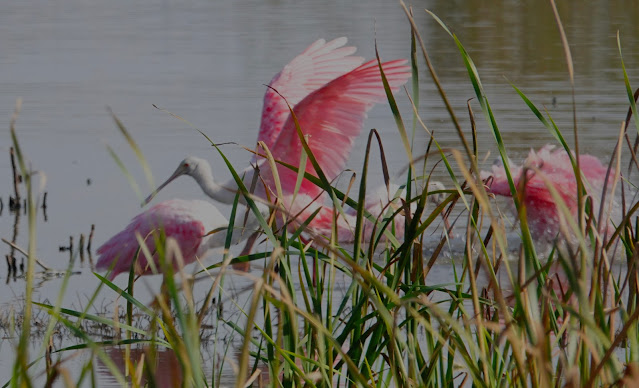
Roseate Spoonbills on Big Slough

Roseate Spoonbills on Big Slough
Showing posts with label Anahuac National Wildlife Refuge. Show all posts

Sunday, January 16, 2022

Visiting a Favorite Refuge with New Friends

 Our Volunteer Village has more than doubled in size with the arrival of two new volunteer couples. My free time schedule overlaps each of theirs by one day. Dee, Steve and I started talking about good birding places and I invited them to join me to visit Anahuac, the refuge where I volunteered while still working and the first refuge I volunteered at when I started my residential volunteer life. 

I further offered to give them the service I used to give people when I volunteered as a free birding guide for Birding Pals. I would bring lunch and guide them. Then we could enjoy a sunset supper at a restaurant on Bolivar Pennisula, along the intercoastal canal before catching the Galveston ferry. 

We had a wonderful day, but didn't even have time to visit all the parts of the main refuge, much less get to the Skillern Unit. But come along.....


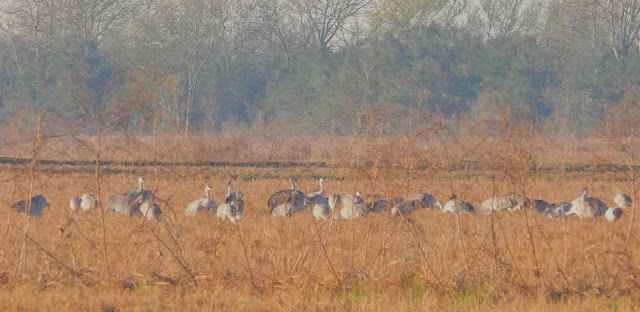
I was completely unable to refind the whooping crane, but we found a field with several groups of sandhill cranes


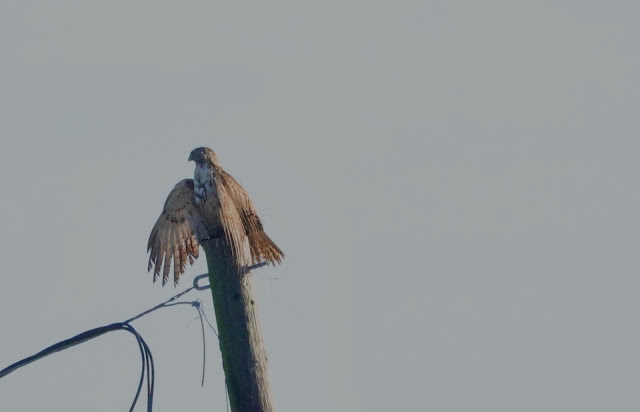
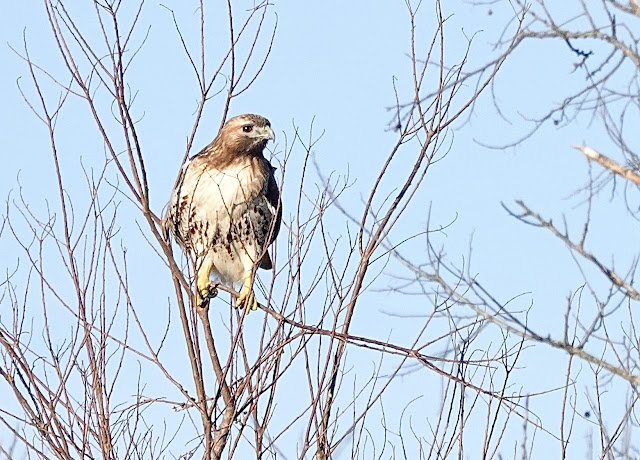
The first bird we photographed was this red-tail hawk warming himself in the early sunlight


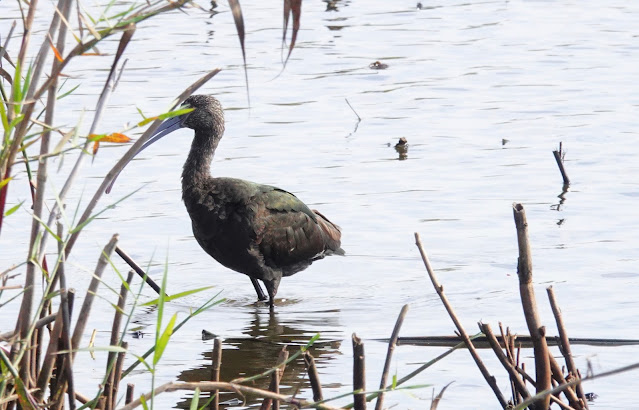
We started seeing lots of white-faced ibis as soon as we started around Shoveler Pond, the auto tour


Many species of birds were hunting together - the ibis' bill is backlit


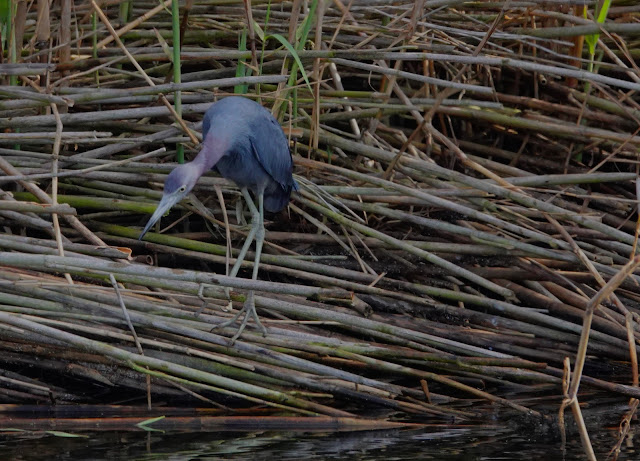
This little blue was with the above two birds, just a bit too far apart to make a good picture


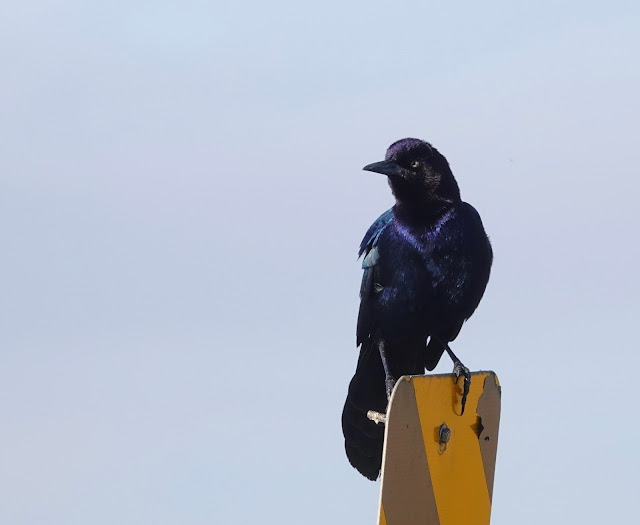
One of the birds people make a particular effort to find  here is the boat-tailed grackle. Dee and Steve could tell boat-tailed grackles from the more common great-tailed grackles with just a few looks. These birds are slightly smaller, have a MUCH rounder head, a smaller bill, and a blue iridescence


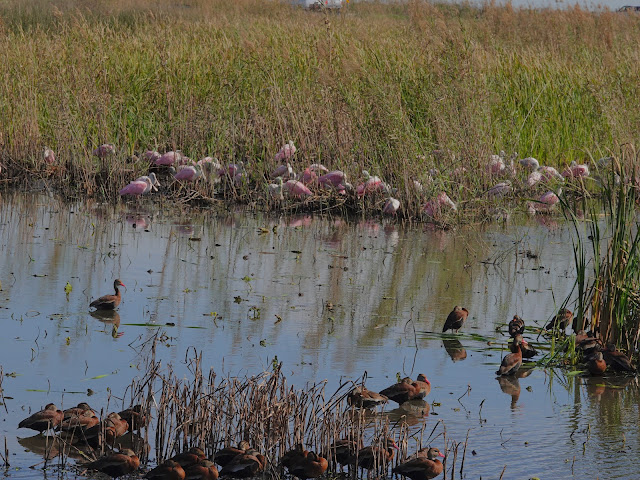
After coots and common gallinules, the two most common birds were black bellied whistling ducks and roseate spoonbills
 

It seemed some of the birds were starting early courting behavior. I'm not sure if this was courting or fighting


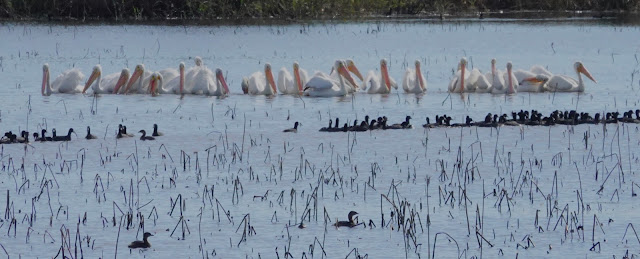
We spent another several delightful minutes watching these white pelicans cooperatively feeding


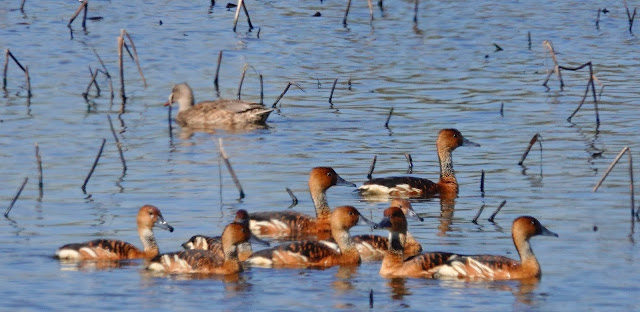
The birds I got most excited about were about a dozen fulvous whistling ducks.  I haven't seen any for over a dozen years.


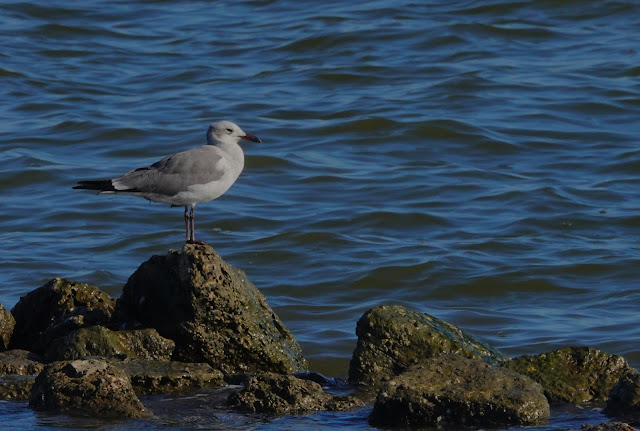
We made it all the way to the end of Frozen Point without seeing many birds, except for a
few hawks. But this laughing gull ...


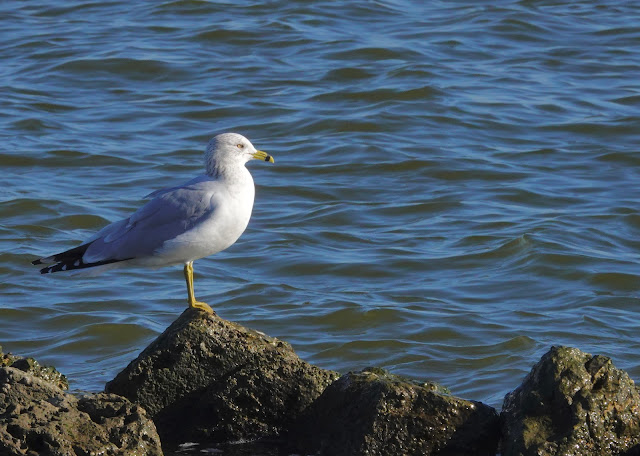
...was hanging out with a single ring-billed gull


We saw several red-tailed hawks but I liked this one's pugnacious expression best


The last time I visited here only a couple of weeks ago, I got to watch several large flocks
 of snow geese and greater 
white-fronted geese fly over. This day, we only saw about
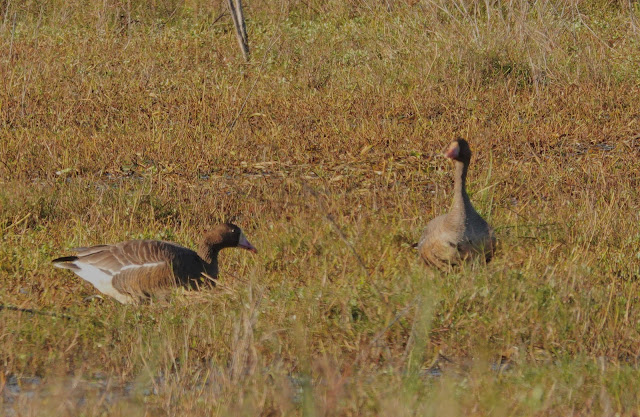
15 greater white-fronted geese on the ground 

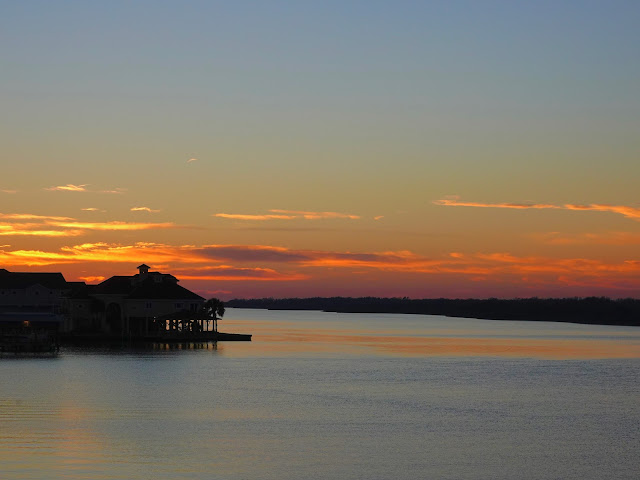
All too soon, and before we could even finish traveling all the roads at the main refuge, much less visit the Skillern unit and do some hiking, we realized, that to take the ferry home and get back about 8:00, we needed to start to the restaurant. When I was last here, Stingeree's, a restaurant that has ALWAYS been here, was closed. I found Steve's Landing which is also on the Intercoastal Canal and only a few miles east of Stingeree's. The food was outstanding, and I figured we could eat outside and enjoy the barges and other boats on the Intercoastal, as well as sunset.  Dee and Steve agreed and we had a lovely meal with  great entertainment.


This shrimp boat came to the marina next to the restaurant

The day was done and so were we


For my eBird list, click here: https://ebird.org/checklist/S100745702


Sunday, January 2, 2022

Chasing Birds

 On my last days off, I decided to wander where my spirit moved me and see how many birds I could photograph.  I first went south to San Bernard where there were few birds and none willing to come close enough for pictures. I was only able to get a eastern phoebe along the trails. The ponds only had common gallinules and American coots except for one alligator and two blue-winged teal.  The auto tour felt like Brazoria, with lots of coots, gallinules and blue-winged teal. The most activity was at the viewing platform, which had lots of herons, egrets, ibis, and teal. 


Eastern phoebe


The viewing platform was getting a lot of use

By late morning, I was starving, so set my GPS for On the River Restaurant in Freeport. The meal was delicious.  I checked out the Old Brazos River across the street, but only found a an osprey. Soon I was on my way to Galveston to catch the ferry. 


Osprey

That trip lasted much longer than I expected, as it took three ferries to get all people ahead of me across.  So I ended up crossing at sunset and not getting to bird Bolivar, North Jetty and all the other birding hot spots along the way.  I got excited about eating at Stingaree Restaurant only to find it was closed.  So I checked what other eateries were along the way.  I found a new-to-me Steve's Landing Restaurant.  It didn't have nearly enough wait people for the crowd, but the shrimp tacos were by far the best I've ever eaten. 


Sunset from the ferry


Sleep spot

My goal for the following day was to be at Anahuac National Wildlife Refuge at sunrise.  I slept at the rest stop in Chambers County where I enjoyed the lullaby provided by the eighteen wheelers. The sun and I arrived simultaneously at the entrance to Anahuac. I started off the day by watching huge flocks of geese fly out. I had fun driving around the auto tour, although there were fewer birds than I expected. 


Dawn sky filling with birds


A flock of white-faced ibis


A closer view of a white-faced ibis


One of a few visible alligators


A distant view of black necked stilts


A pair of caracaras


I finished up my Anahuac tour by going to frozen point, stopping to photograph the huge flock of black bellied whistling ducks. 


A fly up of black bellied whistling ducks


A pair of very tame neotropic cormorants


I also wanted to find to find the whooping crane that has been spending winters near Winnie, Texas. I used the coordinates provided by e-bird and found it in the same field where it was originally reported. After enjoying some time with it, I went after supper and another night at a rest stop. 


Whooping Crane


My next mission was to find the limpkin reported at Sheldon Lake Reservoir, so I got up in time to make the hour's drive in time for sunrise.  I was a few minutes late, but still got some pretty cloud pictures. I saw another birding couple and went to see what they knew.  We ended up looking for the limpkin for about an hour, while I shared my favorite birding places with them. After about an hour, we found not one, but two limpkins sitting in trees. We moved around to try to get a view that wasn't directly into the sun.  They sat around patiently for several minutes, before  disappearing into the swamp to feed on invasive apple snails.  We were joined by several other birders, including one that arrived after both birds had disappeared.


Sunrise was blocked by clouds leaving this view


The first limpkin flying off


While the second finished up its toilet


By this time, I was hungry and done with birding, so I continued on to spend a couple of days with Natalie and cook a New Year's Eve dinner before driving back to work New Year's Day, 

Happy New Year. Surely this will be the year COVID will become endemic.  Be safe.


Wednesday, March 18, 2015

Wild Bird Wednesday: In Search of Migrants

Last Saturday we got to see the sun for the first time in many days.  (I think it was more days than I have fingers.) When I heard of it's imminent appearance, I decided to go to Anahuac NWR and near by High Island, one of the top ten birding destinations in the country during spring migration.

I think I remember you, Sun.  At Anahuac NWR

I got up, made a quick breakfast and packed coffee to go, grabbed my gear and my already packed lunch and water and took off.  A ferry was loading as I arrived at the ferry launch and I only had to wait about 5 minutes for it to start its journey.  I thought it would be fun to find somewhere along the coast to take a sunrise picture, but I was so early, that I got all the way into Anahuac before the sky colored up.  I went on down towards Frozen Point and then stopped at a canal where the main string crabbing is done, to watch the sun come up and the birds begin to fly from their roosting to feeding areas. Then I spent a lot of time driving around Shoveler Pond and walking through the butterfly garden and then taking the boardwalk all the way to the Willows.


This osprey let me get very close while he wrestled with the wind, fish and thin perch. 


View of ponds to right of Shoveler at start


Common gallinule - think it was catching bugs


Since only common birds were around, I checked out some of the grackles to see if they were boat-tailed or great-tailed. Here is a boat-tailed male - with a brown eye and a more rounded head. The blue iridescence doesn't show up in this picture.


A male boat-tailed grackle singing


I saw no warblers, except for one yellow-rumped, but was happy to visit "my" trees. As part of the 1000 hours I worked during the first 11 months of my volunteer life, I worked in many different ways to get trees replanted and then watered through the worst drought we had had in Texas. I'll add the blogs that tell that story if you haven't read it.  (Check out the links at the end of this blog/) These trees now feel like my children. Many of the trees didn't make it but maybe half of them did, and some of them are now getting pretty big.


Mulberry trees - 5' when planted 4 years ago

The catbirds will be excited to find mulberry fruit here in late April


A line of new willows along the pond in The Willows

One tree we really wanted to reinstate on the refuge was Hercules Club, AKA Devil's Walking Stick.  Only this tree and live oaks grow on the refuge naturally. All these trees were completely eradicated by Hurricane Ike and the Friends of Anahuac could find no sources to buy new ones.

Imagine my delight when I found little foot-high seedlings popping up.  On another tour, I'd like to spread these around down the Hackberry trail, where they used to grow.  But it will take great care to avoid personal injury.  These trees are great for wildlife providing food, and most importantly, shelter, because snakes don't climb into these trees and eat eggs and baby birds from their nests.


Wonder how they got that name, Devil's Walking Stick

The Devil's Walking Sticks are Leafing out

I made a quick stop at Boy Scout Woods at High Island to find several people finishing up the cleaning of the buildings and getting everything ready to officially open next Friday.  A western tanager, a black and white warbler and a yellow-throated warbler were the only migrants around and I didn't spot any of them.  But a visit to the rookery in Smith Woods was more productive.  The rookery is starting up and currently has great egrets, roseate spoonbills, and neotropic cormorants hanging out and starting to breed. 


Lots of roseate spoonbills seemed to be saving real estate (note header for longer view)


Neotropical cormorants were already sitting on nests

The egret on left seemed to be building a nest  - maybe didn't want a neighbor this close

This bird has at least two eggs 


It was a good day and I came home tired and happy.


Past Tree Posts

What the Refuge looked like two years after Ike and what the Friends and I did about it. 

We got snowed out and then rained out of two work days when we expected to plant around 400 plants. So I was planting them through May.  The YCC guys helped me get many of them planted. 

We thought we could plant willows in shallow ponds and forget about them.  But the drought dried up the ponds and the baccaris over grew the willows. We had to rescue them.  And I started more willows rooting. 

I negotiated to get button bush cuttings to start in the shade shelter. 

Then got the lagniappe of cypress trees - ending up with over 100 live ones when I left.

Check out more bird blogs here


Wednesday, November 26, 2014

Wild Bird Wednesday - A Visit to Anahuac National Wildlife Refuge

On Friday, November 14,  my wrist was healing well from my carpal tunnel surgery and I found I could hold my binoculars and camera, so I could once again visit one of my special places, Anahuac NWR. This refuge is on the Upper Texas Coast and is only a few miles from High Island, one of the top ten birding destinations in America. It is a winter vacation land for geese, ducks, waders, raptors and some passerines, including vermillion flycatchers. The weather also cooperated, giving an afternoon of good light and warming temperatures, between the first two cold fronts of the season.


A hunting great blue heron

Loafing birds - how many species can you find?

The common gallinule seems to be in decline here 

A great blue heron hiding in plain view

Neotropic Cormorant

Great Egret

One of over a dozen pie billed grebes

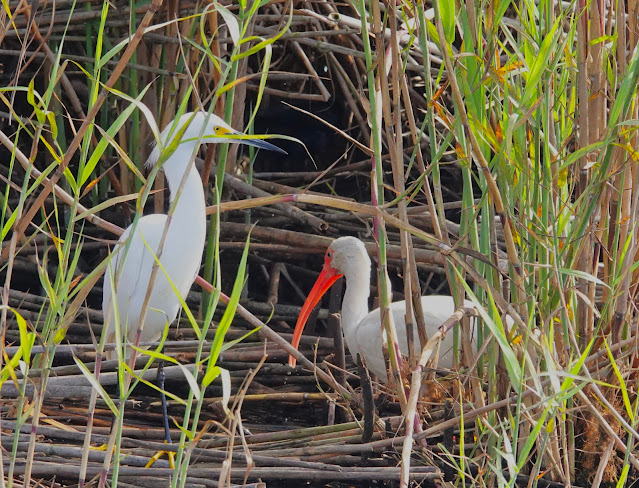
The adult white ibis I saw - but saw over 100 white-faced ibis

A pair of pie-billed grebes were catching the invertebrates the ibis stirred up

There were hundreds of black bellied whistling ducks and scores of these fulvous whistling ducks

Great blue and neotropic cormorants

Swainson's hawk

A western willet showing a hint of his beautiful, patterned wings

The beautiful light on Galveston Bay near sunset


Check out the Gallery at Wild Bird Wednesday