Roseate Spoonbills on Big Slough

Roseate Spoonbills on Big Slough
Showing posts with label Theodore Roosevelt NP. Show all posts

Tuesday, September 10, 2013

Our Theodore Roosevelt National Park Experience - South Unit

There are three separate units of Theodore Roosevelt National Park:  The biggest is the South Unit which is also easily accessed from Highway 94, at Medora. The North Unit, which is much smaller, is about 70 miles north.  There is also Elkhorn Ranch Unit, where Roosevelt built his second ranch.  No buildings are left there because they were built of cottonwood, which rots quickly.

However, his first ranch house was located about seven  miles from the park's Visitor Center.  It was built of ponderosa pine so has endured and has been moved right behind the center. This is the place he bought after he came west to kill one of the last of the wild buffalo and to which he came back to grieve for his first wife and mother, who had died on the same day.

Bob and I went on a little tour led by an Intern Ranger and found it very interesting. Roosevelt was always an ardent naturalist and started doing taxidermy at the age of ten, but it was while he was living here that he developed his conservation ethic. He also felt that the life he lived at the Maltese Cross and Elkhorn Ranches prepared him to be president.

The cabin has three rooms - a living room, a kitchen, and Theodore Roosevelt's bedroom.  It also had a root cellar and a sleeping loft. It was considered luxurious for its time.


The Maltese cabin today

The kitchen

This was Roosevelt's rocking chair

Our interpreter in the living/dining area

Roosevelt's storage trunk that was in his bedroom
Roosevelt was, by far, our most environmental president. Our guide showed us a map showing all the parks and monuments that had been established by him. He was also responsible for the establishment of many national wildlife refuges.

As president, Roosevelt created five national parks (doubling the previously existing number); signed the landmark Antiquities Act and used its special provisions to unilaterally create 18 national monuments, including the Grand Canyon; set aside 51 federal bird sanctuaries, four national game refuges, and more than 100 million acres' worth of national forests.He also created 50 wildlife refuges, commencing with Florida's Pelican Island.  For more detailed information, click here.

Our country would be a much different and poorer place without all the lands Roosevelt set aside for the use of wildlife and for our recreation.

And here are a few pictures from the auto tour of the refuge as well as from the Painted Canyon Visitor Center.  We stayed at the refuge two days and on the third day we broke camp, hiked to the Petrified Forest and then moved to the North Unit.


I'm writing this from the Grand Marais Library on Saturday, September 9. My friends are indeed driving straight through from Texas and will arrive this evening.  I''m camping in Finland State Forest but will go meet them tonight. Tomorrow we'll get everything rechecked and packed so we will be able to leave early Monday morning. I'm sure I'll have a couple of blogs about this trip to one of my favorite places on earth. Last year, I had material for three blogs.  This was my favorite blog from that time.

The adventures continue.

Sunday, September 8, 2013

Hike to the Petrified Forest, South Unit, Theodore Roosevelt National Park

One place in Theodore Roosevelt NP I really wanted to hike was to the Petrified Forest. The trail  is about seven miles away from the Visitor Center.  Taking the trail up and back is only a little over three miles. It can also be done as a loop trail in about 10 miles. We had to drive through the National Grasslands which adjoins the park to reach the trail.

View in National Grasslands
Bob and I decided to do the up and back trip. We wanted to go to the North Unit to camp that night, so we broke camp early and left about 7:00 A.M. We had to stop many times on the way to the Trailhead to take pictures because the  National Grasslands  was a very different habitat, with rolling hills of grass interspersed with a few of the Badlands features. We also found some oil wells scattered along our route. And we had to stop once to enjoy a pronghorn antelope with his harem of females. 


Cow and calf looking for grass by a butte

I couldn't resist this face

Pronghorn buck with his harem

View near trailhead

We finally got hiking around 9:00 A.M. Almost immediately, we met a bull bison grazing very close to the trail. I carefully watched his body language as we eased by him. I made sure to talk to him so he would know we were there. He just kept grazing and switching his tail and ignoring us so we kept walking until we were by him.


The Very Close Bison - I took this picture after I was further away from him

I was surprised by a cactus growing by the first piece of petrified wood we found


Bison patty world
  A short distance later, we found the trail branched. One branch led to the Petrified Forest, and the other was part of the loop trail. It had a herd of bison down it so we went down it a little ways until we could get pictures of the bison , then turned back and took the trail to the forest. We had found one fossilized stump in an outcropping just before the trail split. But then nothing but rolling hills of grass with distant outcroppings. Bob finally got tired of the flat, grassland walking and went back to the car. Within another two tenths of a mile I went through a wooded draw and came into a whole different world on the other side.


Long view from the petrified forest area

The park says rocks that make up the petrified forest in the park's South Unit came from huge dawn redwood, magnolia, ginkgo, cypress, date and palm trees that once provided shade from steamy heat 60 million years ago when this area was a swamp.

Some stumps shone like jewels

 For the next half mile, there was petrified wood everywhere. Most of it consisted of short stumps that looked like they had gone through a cataclysmic event that mostly shattered them. A few stumps were still in the ground, but appeared to have been smashed. And there were chips of wood everywhere as though a giant had been chopping many cords of wood.


One of the few stumps still in the ground - note the chips around it

Stumps scattered across the landscape

A log on some of the native clay

Stumps and surrounding prairie


An imposter - but it posed very well

The longest piece of wood I found - but it was only about 6 inches thick and looked like a slab

 Of course, I took lots of pictures as I came in.After I turned  back, I hurried so Bob wouldn't have to wait too long, but found pictures I'd missed on the way in that I had to take.
Had to stop several times to enjoy these recyclers of bison poop

This was a stunning, beautiful, and easy hike. Definitely one for your bucket list if you plan to visit this area.It was the easiest hike I've done on this trip.  Mostly flat with very little elevation changes and those were were short.

I'm finishing this blog in a suburb of Minneapolis, Friday, September 6.  I dropped Bob off at the Bus Station and then checked the alignment on my car as we hit several bad bumps while in North Dakota.

I'll be meeting my paddling friends tomorrow night or Sunday and we'll be paddling Monday morning.

For the entire collection of my pictures, click here.

Wednesday, September 26, 2012

My Bad - Missed the North Dakota Badlands

I usually plan - or at least leave time for - at least one adventure a day. I think if you don't live your  journey, your destination is not as big a payback.

But I was trying to make sure I got back to Bozeman in time to run some errands like getting my hair cut and buying some new fleece outerwear to replace my twenty year old pants and jacket that are beginning to fall apart. So I didn't pay much attention to what was available to be seen in North Dakota and mostly planned to only stop at a library and try to get more pictures edited and get blogs ready for the hiatus while I'm camping in Yellowstone.

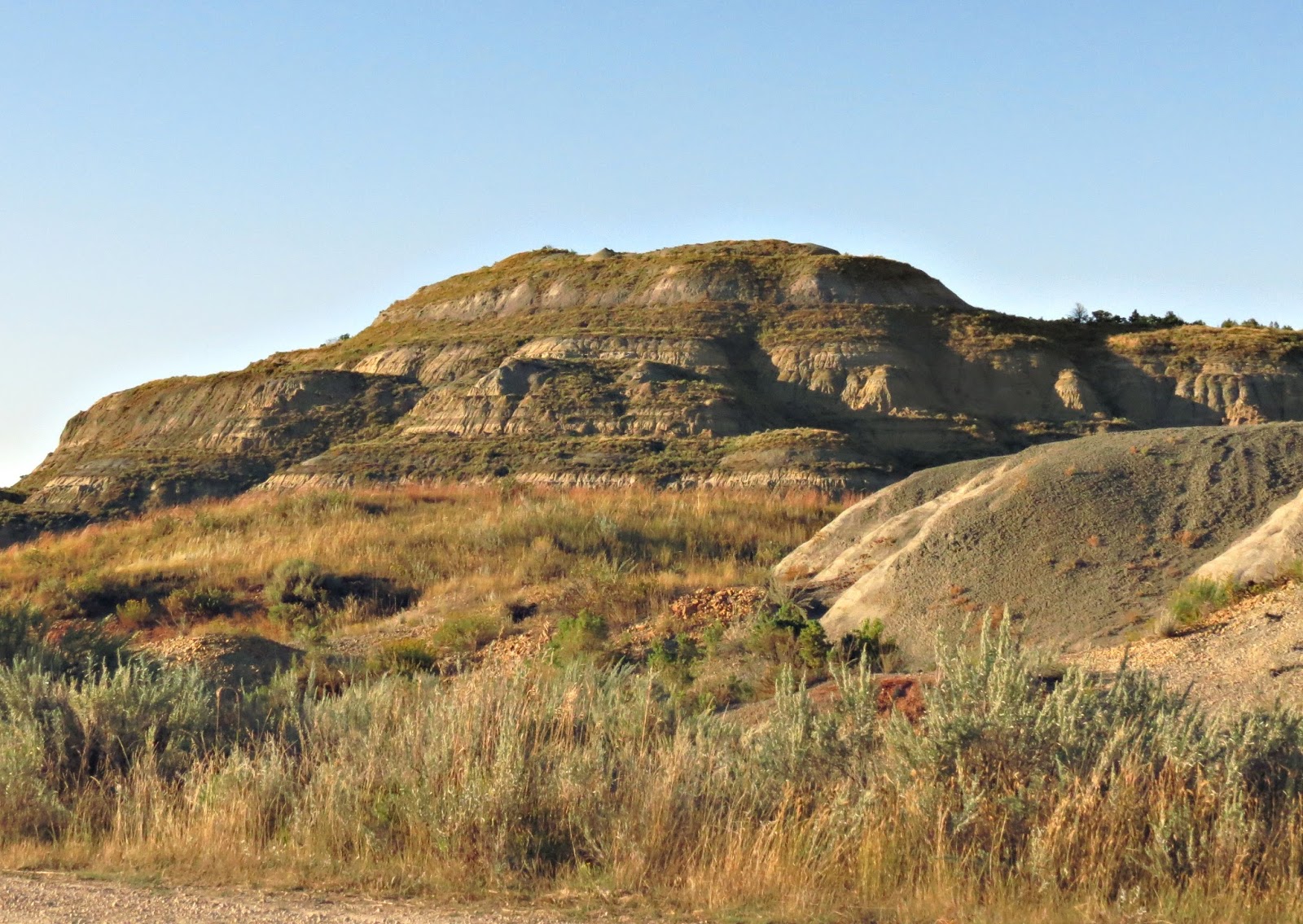
So imagine my amazement when I saw badlands and then came up to a rest stop at the edge of Theodore Roosevelt National Park and found there ARE more badlands to be seen. And many of the hills are on fire because brush fires have ignited veins of lignite within the hills and they are baking the hills until they turn red.

Another geological force at work here is slumping.  House-sized pieces of the hill fall off and then take years to slide down and be dissolved by rain. In fact a major slump has closed part of one of the scenic roads in the park while the slump is removed.

And there is a major petrified forest within the confines of the park.  But it would have taken me forty minutes to drive to it and then about three hours to hike through it without a camera.  With a camera, I might still be there. So I decided to just put this on my bucket list for next year.  Tent camping is only $7 per night with the Golden Age Pass. The Little Missouri River runs through all three units.

Here are a few pictures to give you a little teaser. For more information, explore this site. 


This park also has lots of information and artifacts from Theodore Roosevelt for you history buffs. You'll have to check to see which of the visitor centers has his material.

On the personal front, I'll be hiking with two friends in Yellowstone National Park when this publishes. Can't wait. I do need a little rest from these vacations, but I'll be ready to start them up again in November.