Roseate Spoonbills on Big Slough

Roseate Spoonbills on Big Slough
Showing posts with label Okefenokee National Wildlife Refuge. Show all posts

Wednesday, April 23, 2014

A Last Look at Okefenokee NWR

Spring was racing across the swamp and  the upland longleaf pine ecosystem, spurring new growth, sending off some birds and bringing in others. I had to hit the brakes a lot to document the first of the year arrival of wildflowers, and birds and the more active snakes, turtles and frogs.  Even the alligators look prettier in the colorful reflections. I was excited about all the new arrivals and changes, but sad to know I would be gone before all changes of spring happened. I did miss many of the migrants, but enjoyed seeing some of them arrive. I also got to enjoy a few of the earliest spring wildflowers. And I made lots of visitors happy by telling them where to find blooming plants, including several species of carnivorous plants,  and the best places to look for migrating and nesting birds.

This is a bull alligator that was probably visiting the female that lives in this pond


One of three non-migrating sandhill cranes that  are often seen or heard from the Cane Pole Trail


A Carolina wren singing his heart out

Love those bulgy green eyes of the pig frog - reddish leg color due to color of tannic water


Displaying anole


Friendly rat snake at the tower - it could climb the open fence


The prothonotary warblers started coming in two days before I left


One of many great crested flycatchers that arrived at the refuge just before I left


Got to see blooming hooded pitcher plants


Along with parrot pitcher plants


And blue-eyed grass
On one of my earlier roving days I found a little family admiring a softshell turtle that was sitting in the road - probably a female looking for a good place to lay her eggs. The mother gave me permission to use the picture in the blog. This is the main reason for roving - sharing special plants and animals with visitors while helping them understand the purposes and management practices of the refuges.


Florida softshell turtle admirers

On the personal front, I made it to Galveston after stops for a last playdate with my  new friend, Julie, who took me on a lovely paddle, and  a short visit with one of my oldest friends, Hulin.  I got to Galveston just in time to do an exploratory paddle on the upper reaches of Cypress Creek, a lovely creek that winds through a heavily populated part of Houston, with several friends. Then I attended Tracy's marvelous welcome home party where I got to see many more of my friends.

This past weekend I went with friend Natalie, my hostess, to a tracking dog trial and then to a tour at Peckerwood Gardens, a fabulous place dedicated to finding plants from all over the world that will grow well in Houston. Now I'm getting doctor visits done and hoping to do some birding and visit with other friends.


My car in moving mode


Wednesday, April 9, 2014

A Stupendous Day

Last Wednesday was possibly the most awesome day of work I've done here. My boss, Gracie,  paired me and a new volunteer friend, Barbara Kramer, up to roam together. I suggested we roam on our bikes but she couldn't carry her big camera so counter suggested we get the little electric cart so loved by Judy Bell, another blogging volunteer friend who has worked here in the past.

Here are my reasons for choosing it as the best workday of my stay here.

Reason One - I got to enjoy Barbara's enthusiasm.  She is way into birds and flowers.

Barbara taking her turn at driving the cart

Reason Two  - I got to appreciate Barbara's passion. It comes through in conversation with our visitors and with me.

Reason Three - I got to delight in Barbara's humor and the back and forth between us.

Reason Four - I got the benefit of Barbara's knowledge. And both of got to learn new things. And take LOTS of pictures.

Reason Five - We had a ball driving the electric cart. It also let us get better views of wildflowers trying to hide out of view of the drivers along the auto tour. And we got to talk to a lot of the visitors passing by in cars.


Me driving the cart

Reason Six - I not only got lots of pictures of a Bachman's sparrow, but caught it singing. This is a very elusive bird who very quietly skulks among the saw palmetto fronds and is seldom seen.


Bachman's sparrow singing 

Reason Seven - We met several local families out with their children during spring break and enjoyed helping them see snakes, frogs, a racoon, and a red-shouldered hawk. We also explained the long-leaf pine ecosystem to other visitors. And we showed and discussed a moma racoon out foraging at noon along the boardwalk.


Nursing momo coon foraging at midday

Reason Eight - for the first AND second time, I finally had my camera when a Sherman fox squirrel was close enough to photograph and sat still for a few seconds. I got the same squirrel at different times of the day.


Sherman Fox Squirrel

Sherman Fox squirrel

Reason Nine - Barbara and I found the first of the year  Lady Finger Lupine (Lupinus villosus) blooming.


Add caption

Reason Ten - We got to get closeup views of the staff doing a controlled burn.


Controlled burn near the maintenance area

If Barbara hadn't had to leave at four, we probably would have had a hard time getting back by 7:00 P.M., although we usually are back around 4:15 PM. Stopping work is definitely harder than starting it.

I'm completing this blog on my next to the last day off before I leave here, if all goes well and I get packed up.   I'm just back from three wonderful and busy days, having fun with my new friend, Laurel who lives in South Carolina. (have material for a few blogs) I have four more days of work, then hopefully a visit to one of my new friends, Julie.  I'll leave a from her house and go see an old friend, Hulin, in South Louisiana.  I should get back in Galveston a week from this Thursday. I have a few parties to go to, a few doctor visits, and some adventures with my friend, Natalie. I'll migrate north in early May.


Tuesday, April 1, 2014

Born to Burn

Ecosystems are built around climax species.  In arid lands, these might be grasses, but in wetter areas, the climax vegetation is usually deciduous trees. But there are many ecosystems that exist between grasses and a decisuous forest.  Here at Okefenokee National Wildlife Refuge, one of our ecosystems is a longleaf pine ecosystem  made up of mostly pine trees with a saw palmetto, saw grass,  and shrub understory.  It is called a fire climax community because it has to have frequent fires to maintain itself. 

This system is made up of plants and animals that have developed to live and do well through fires. Some species must have fire to regenerate and the others depend on fire to keep down competing species. The climax species of this ecosystem is the longleaf pine. This a a long-lived pine, living 3-400 years if left to die naturally.

I found this controlled burn with one little hot spot a few days after the main burn a day after I arrived at Okefenokee NWR

The long leaf pine ecosystem once stretched from the coastal plains of Florida to East Texas and comprised some 90 million acres. Today, we have lost 97 percent of that  ecosystem and only have about 2 million acres in scattered blocks.  About half of this is on public lands.

This tree is dear to my heart because, as a young teenager, I moved into an area of Louisiana that had these trees and fell in love with them.  And I have worked to save this ecosystem and it's some 30 plants and animals associated with it that are threatened or endangered, including the star bird, the red-cockaded woodpecker. 

The longleaf pine can't grow in areas that have a lot of dead materials on the ground because the seed can't make good contact with the earth.  Frequent fires keep the undecayed organic material low so seeds can get their start. It also keeps shrubs from overgrowing the young trees and shading them out. 

The seedling comes up as just a bunch of needles.  This stage is called the grass stage and lasts a few years. Nothing much happens above ground, but below the ground, the tree is making an extensive taproot system. If a fire burns across a tree in the grass stage, it may lose its needles but keeps on living and just replaces them. 


Then the tree shoots up 2- 3 or more feet in the next year.  Trees that have only a stem and a top knot of needles are often said to be in the candlestick stage.  They are not resistant to fire in this stage but can usually reach eight or more feet in just three years, after which time, they start to develop a bark thick enough to again make them fire resistant.  They hold their needles, who burn very easily, high above most ground fires. 


A tree that has probably been in the candlestick stage for a year

After eight years, the tree continues to develop thicker and thicker bark which can just flake off if it catches on fire. And even if the outer part of the bark burns, the tree will survive. 


Bark of a tree that has survived a recent fire

These trees are pretty easy to identify.  They have long needles - 8 to 18 inches with (mostly) three needles in a little base called a fascicle. Then grow about  125 feet or more tall and 3-4 feet in diameter. (I did have a friend who told me he has seen pictures of longleaf pine trees so big in diameter,  that only one tree would fit on a flatcar, after it had been sawed to length. (So the entire tree had to be carried by several flatcars. )


The three needles in a fascicle

Longleaf pines have large, beautiful pine cones. These at Okefenokee are smaller than are the ones I'm used to seeing in Louisiana.  They make wonderful frosted Christmas trees,  and great suet feeders. (Once I turned one upside down to prevent house sparrows from landing on it and ended up teaching them to hover while gobbling down the suet I wanted  to only serve to the chickadees, wrens, and woodpeckers.)

Longleaf pinecone on tree

When the pine cones are wet, they are shut.  They dry, open and expose their seeds

Pine cones are monoecious and have male and female cones. The female cones are the big ones we see on the tree.  The male cones are tiny, and fall off the tree as soon as their pollen has blown away to fertilize the female cones. 

Two male cones lying on the ground

Longleaf pines are the favorite nest trees of the red-cockaded woodpecker who also depends on fire to remove the understory and keep the trees thinned out.  This woodpecker is the only one to drill holes in a living tree. It takes it up to two years and is helped if the tree has red-heart disease, which softens and then rots the heart of the tree. 


The white rings mark trees that red -cockaded woodpeckers have drilled holes 


Sunday, March 30, 2014

Yes, I'm Working.... Check out my shirt.

If I have an assignment to rove or lead a tour , I have a hard time remembering to stop working. Mostly, I feel like I'm playing and gathering up new friends as I move around, or as I get involved in  interesting conversations. And  before and after my scheduled work hours, or on my days off, I'm doing the same thing.  So the only way to tell if I'm working, is to check my shirt. If I'm in my official shirt, I must have had to work eight hours during that day.


The red maple seeds look especially beautiful against the Spanish moss

These plants have been blooming a few weeks

Right now the refuge is changing each day.  New trees are leafing out, and new wildflowers and blooming shrubs are appearing.   I need to find all this new vegetation and then help visitors find it. Winter avian visitors are leaving while migrants are stopping by.  Gotta keep tabs. Resident birds are nesting or raising young. I even saw a pair of fledgling owls on my last boat tour. (It is also part of my duty to take frequent boat tours so I can advise visitors of what they will see by boat - and I can't wear my shirt, so you'll have to take my word for it - It's WORK.)


One of the palm warblers that were still here early this week


On one of the tour boats reaching Chesser's prairie


I worked hard to get this sunset from the sunset tour boat

This past week, I went out with another volunteer to rove.  We assigned ourselves the task of finding every blooming species of plant, picking the best sites for each species and then learning the location so we can describe both the flower, and the area in which to find it.


Willow blooms - pollinators love them


Volunteer Barb and I found several Osceola's Plume, Zigadenus dengus


Osceola's Plume Close Up


Orange milkwort, Polygala lutea - one local name is Swamp cheetos

Barb found these newly emerged Pink Sundew, Drosera capillaris, but now I can locate them too

On another work day, as I was getting ready to count birds on the Cane Pole Trail,  I met a visitor I've met a few times before - she and her husband are wintering her and come by often.  She was interested in both birds and plants.  We started off by counting all the bird species we could find on the Cane Pole Trail. She was able to get some gorgeous pictures of a Prairie Warbler.  That just may be the most cooperative warbler we have.  It forages low and slow so you get lots of clear looks at it. We didn't find a Palm warblers but I had found them while "working" a day or so earlier.


Palm warblers are heading north

Mary was kind enough to send me a picture of the prairie warbler we found.  Thanks Mary

After that we went on down the auto tour, stopping to look at all the flowers I'd discovered and also looking for the just-up sundews.  We ended up spending about three hours together and found six parrot pitcher plants trying to regrow, two with flower buds on them. Then we had her husband take our picture on both our cameras.

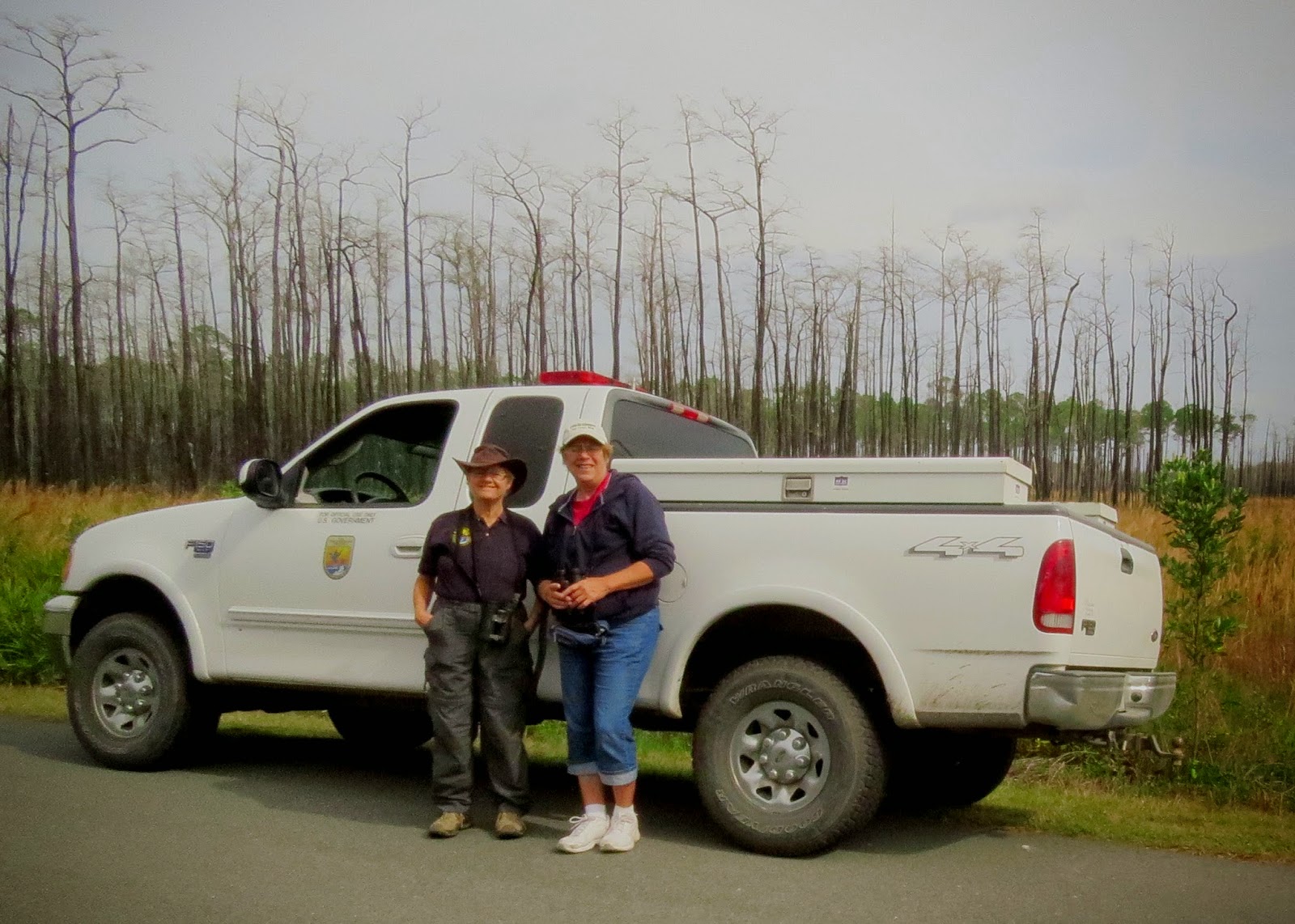
 Me with my new friend, Mary, after finding six parrot pitcher plants,  Note the shirt, and the truck - a sure sign I'm working.

I also had to wander around the boardwalk by myself, between visitors, but got to enjoy our blonde raccoon that forages near the beginning of the boardwalk.  It is being seen often enough that we tell early and late visitors to watch for it.  On one day, I spent about ten minutes taking pictures of it.


Blonde racoon foraging

I also find lots of puzzling things.  One of them appeared to be a bundle of male longleaf pine cones.   If you know what this is all about, please share.


Mysterious bundle

Friday I grabbed my clothes out of the dryer in the community trailer during my lunch break and then noticed some big greenish-white blooms nearby. They were pawpaw blooms. So I went around looking for more as part of my afternoon job.


Pawpaw plants among the saw palmetto


They just get prettier, the closer I got to them


Intricate blooms start off green and then turn white

Saturday, I was supposed to lead a boardwalk tour but no one showed up.  I just roved down the  boardwalk,  and was able to share alligators, turtles, birds and the first magnolia bloom with visitors, including a German couple.  Earlier, I also found a red-shouldered hawk nest that is just past the canoe launch site. The nest is mostly invisible but I watched the male red-tailed hawk come screaming in with a large lizard.  Then I heard the female talking to the babies.


One of the pig frogs I help visitors find and identify

Another way I can tell if I'm working or not is by the sunset.  If I'm looking at one, I'm NOT working because the refuge closes before sunset and I have no work to do.  (At least that's true unless I'm on the sunset tour boat.)


Relaxing after yet another hard days work

 On the personal front, I'm down to just two more adventures and 8 days of work before I'll be packing and leaving April 15.  Tomorrow I'm off to paddle the Altamaha River for two days with Julie DeVore who was my guest blogger recently. This will be our first real meeting but I feel I know her well after lots of chats via e-mail and phone.  Next weekend, I'm going to visit another new friend that I met while WORKING here. We'll be paddling and birding ..... stay tuned for the details. Probably lots of hard play will be involved.