Roseate Spoonbills on Big Slough

Roseate Spoonbills on Big Slough
Showing posts with label FWS Volunteers. Show all posts

Sunday, January 16, 2022

Visiting a Favorite Refuge with New Friends

 Our Volunteer Village has more than doubled in size with the arrival of two new volunteer couples. My free time schedule overlaps each of theirs by one day. Dee, Steve and I started talking about good birding places and I invited them to join me to visit Anahuac, the refuge where I volunteered while still working and the first refuge I volunteered at when I started my residential volunteer life. 

I further offered to give them the service I used to give people when I volunteered as a free birding guide for Birding Pals. I would bring lunch and guide them. Then we could enjoy a sunset supper at a restaurant on Bolivar Pennisula, along the intercoastal canal before catching the Galveston ferry. 

We had a wonderful day, but didn't even have time to visit all the parts of the main refuge, much less get to the Skillern Unit. But come along.....


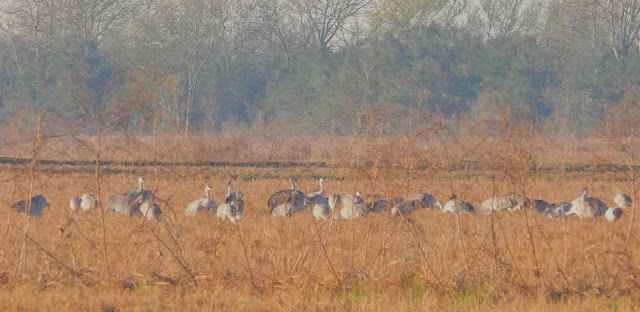
I was completely unable to refind the whooping crane, but we found a field with several groups of sandhill cranes


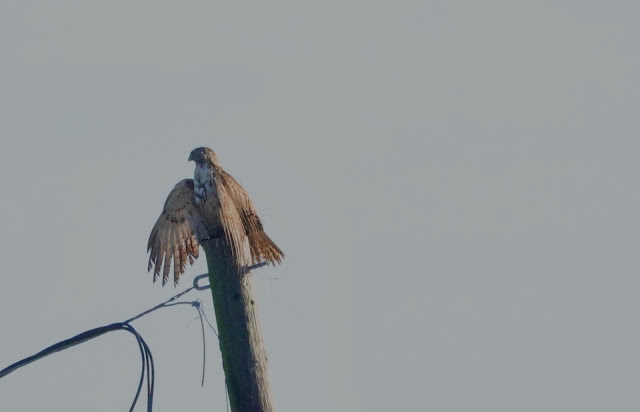
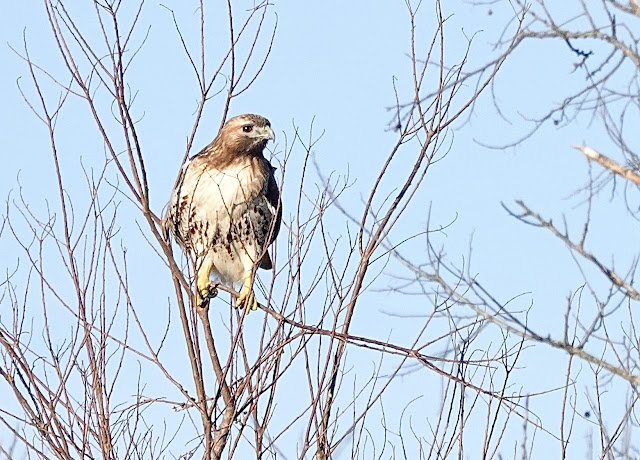
The first bird we photographed was this red-tail hawk warming himself in the early sunlight


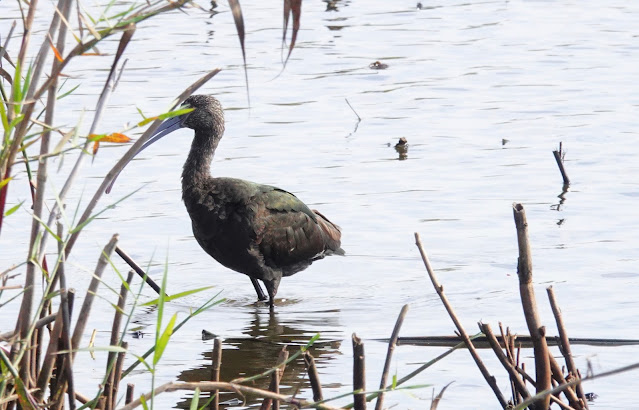
We started seeing lots of white-faced ibis as soon as we started around Shoveler Pond, the auto tour


Many species of birds were hunting together - the ibis' bill is backlit


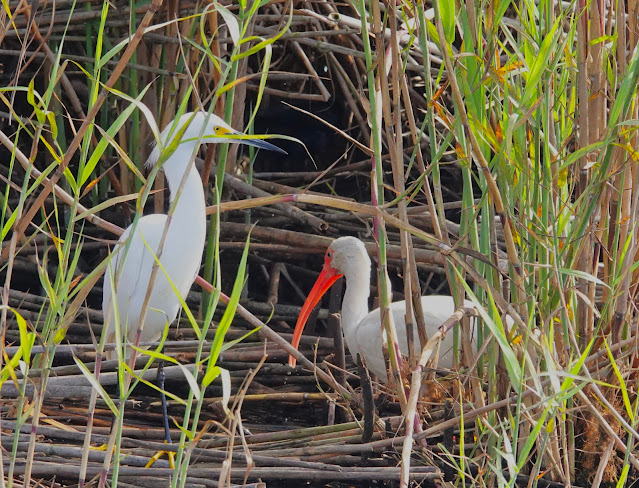
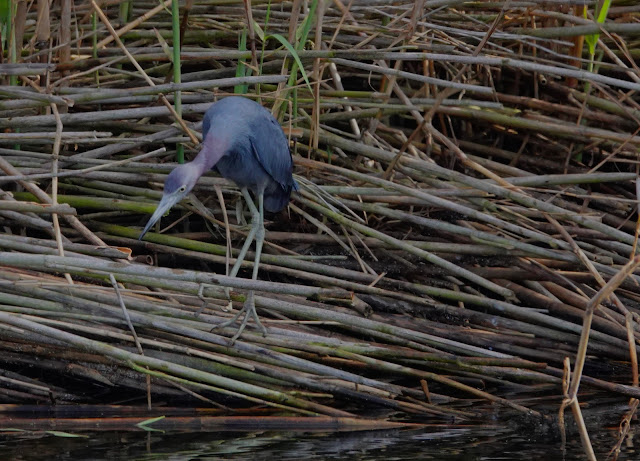
This little blue was with the above two birds, just a bit too far apart to make a good picture


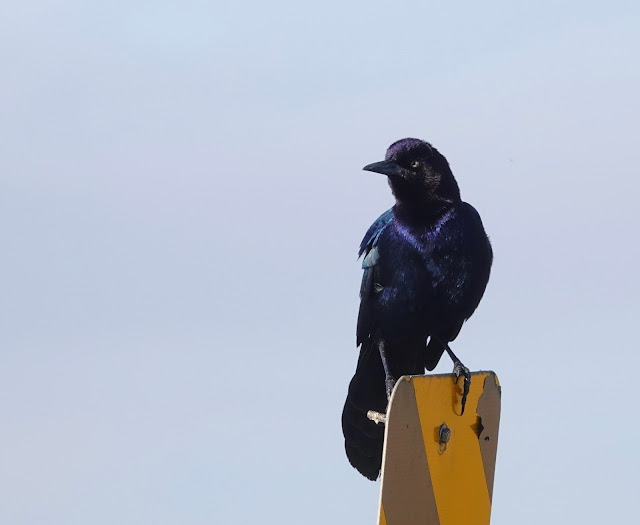
One of the birds people make a particular effort to find  here is the boat-tailed grackle. Dee and Steve could tell boat-tailed grackles from the more common great-tailed grackles with just a few looks. These birds are slightly smaller, have a MUCH rounder head, a smaller bill, and a blue iridescence


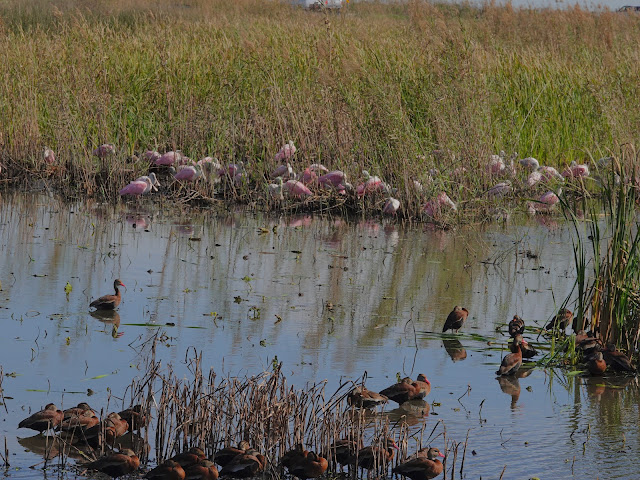
After coots and common gallinules, the two most common birds were black bellied whistling ducks and roseate spoonbills
 

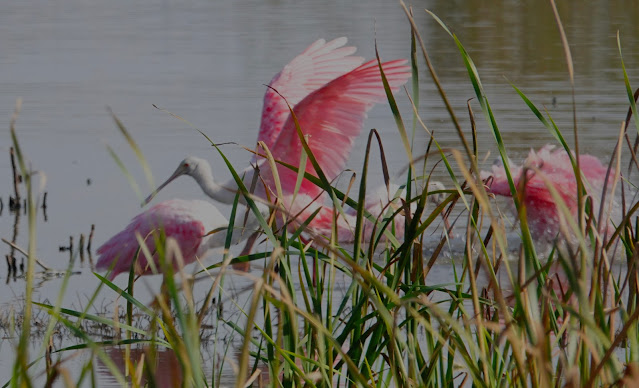
It seemed some of the birds were starting early courting behavior. I'm not sure if this was courting or fighting


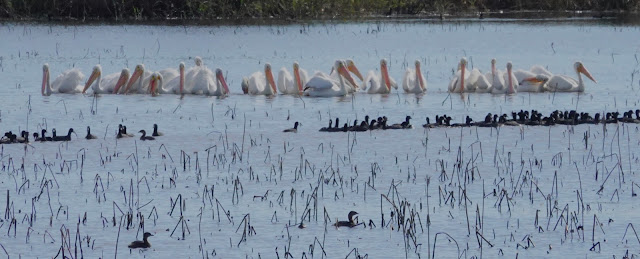
We spent another several delightful minutes watching these white pelicans cooperatively feeding


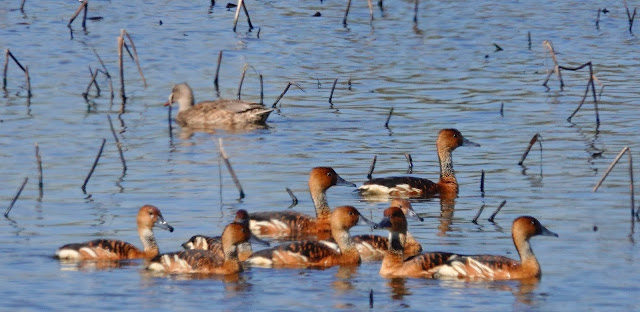
The birds I got most excited about were about a dozen fulvous whistling ducks.  I haven't seen any for over a dozen years.


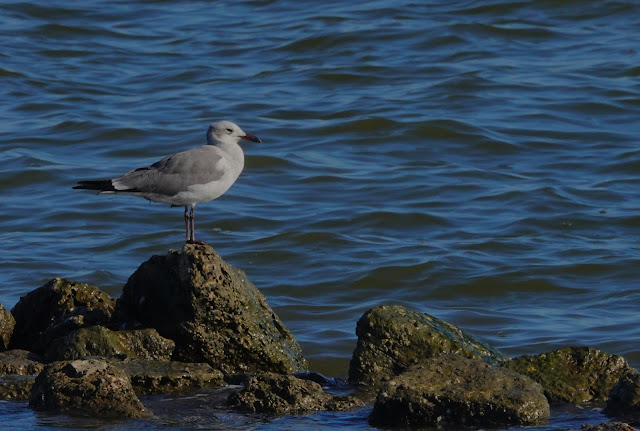
We made it all the way to the end of Frozen Point without seeing many birds, except for a
few hawks. But this laughing gull ...


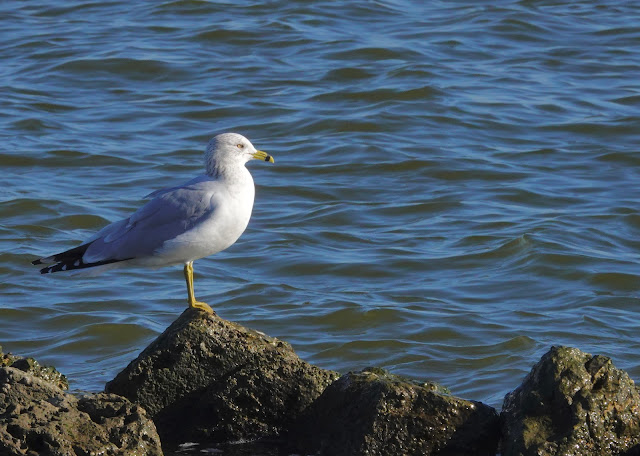
...was hanging out with a single ring-billed gull


We saw several red-tailed hawks but I liked this one's pugnacious expression best


The last time I visited here only a couple of weeks ago, I got to watch several large flocks
 of snow geese and greater 
white-fronted geese fly over. This day, we only saw about
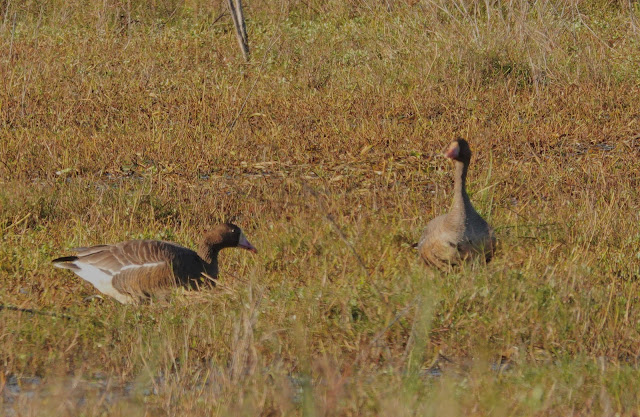
15 greater white-fronted geese on the ground 

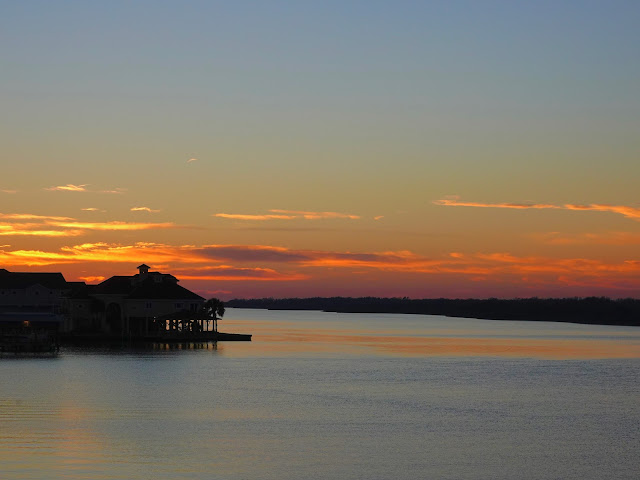
All too soon, and before we could even finish traveling all the roads at the main refuge, much less visit the Skillern unit and do some hiking, we realized, that to take the ferry home and get back about 8:00, we needed to start to the restaurant. When I was last here, Stingeree's, a restaurant that has ALWAYS been here, was closed. I found Steve's Landing which is also on the Intercoastal Canal and only a few miles east of Stingeree's. The food was outstanding, and I figured we could eat outside and enjoy the barges and other boats on the Intercoastal, as well as sunset.  Dee and Steve agreed and we had a lovely meal with  great entertainment.


This shrimp boat came to the marina next to the restaurant

The day was done and so were we


For my eBird list, click here: https://ebird.org/checklist/S100745702


Wednesday, March 25, 2020

Working Tour to Elephant Rocks

March 7, 2020

When I signed up to help with the bus tours, two of them looked really interesting. One was the tour of Blanca Wetlands - see last post - and the other was a tour  to Elephant Rocks with a promise of a little history as well as a demo of flint knapping.  So this was another official working trip but filled with personal enjoyment.

Our leader was Shawn Noonan, from the BLM.  He recruited two helpers from the bureau, but I never wrote down their names so I'll have to try and document them later. I think our guide on the hike was Clayton. I didn't get to the knapping demonstration until after the knapper was introduced.

We got a little of the history of the site. It all began with the mother of all volcanic eruptions, that is the largest EVER, spewing about 3,107 cubic miles of magma in a magnitude 9 or better eruption,  about 27 million years ago. This produced the Fish Canyon tuff, which has been weathering ever since.  The weathered rocks look like herds of elephants, hence its name. The monolithic boulders stretch for five miles.

About 15,000 years ago, this site was used by monstrous grazers, including the columbian mammoth, which stood up to fourteen feet tall and whose tusks were up to 16 feet long. Joining them were the huge Extinct Bison grazing in herds across the landscape.  Word is that there are rocks polished by those huge mammoths, ten or more feet above ground. Today the grazers are mostly mule deer and elk.


Our leader, Shawn helping a visitor get the layout of the area

Shawn talking to us about the area

The talk from the knapper, about the kinds of rocks used for tools, with examples on the table

Knapper, starting to demonstrate how to make a point

Safety is important He caught most of his shards in the bin

He also made is knapping tools 

Closeup of a chip that will become a point

We divided into two groups to go on the guided hikes

I was a little late to catch the best light on the beautiful sceenery

I think our leader is named Clayton.  He made us understand the area much better

Hiking with interpretative stops was great. 

The only child on the tour was this nine year old who reminded me of a puppy gambling back and forth across our trail
Took this picture when almost back from the hike


Shawn looking at the interpretative display on the large ungulates that once roamed here

This was another great tour. It is also a pretty good birding area in the spring and summer and holds some species not found in the lower parts of the valley.

On a personal note, I'm finally taking time to write this - after thinking it was in the queue, on March 25, 2020. It now seems like a dream or something that happened years ago. Since then, we have really been impacted by the virus.  I was just getting instructions to work alone from Fish and Wildlife, when my friend, Cindy, posted that she had just lost her scheduled caregiver that she had lined up for her recuperating period of hip surgery. I talked to my boss and got permission to go stay in California for at least three weeks. I quickly packed up, finished my current assignments, then drove most of a night and a day to reach her. She had gotten her surgery while I was in route, and then got out of the hospital the following afternoon.  I rushed to stock up on groceries before going to pick her up.

Today I learned that I can't come back to the refuge until all this is over, so I'll be stuck in California for the foreseeable future. And yes, Cindy is making remarkable progress, says she is hurting less and moving better than before the surgery, and is working half time from home.


Sunday, March 1, 2020

Colorado Homecoming

March 1, 2020

I left Houston around 4:20 A.M  at 65 ° and made it to Amarillo just in time to meet the cold front with a few bands of swirling snow. By the next morning, as I was leaving just before dawn, it was 19°. My trip soon slowed as I had to stop and admire the scenery, and eat breakfast and do other piddling things. I stopped to take a picture of the pass and had two 18 wheelers pass me.  I passed one and was completely blinded as it blew muddy snow on me.  I had to stop in Alamosa for groceries and for a car wash to get the mud and salt off my car.

At the beginning of the pass into San Luis Valley from the east

My car after getting through the pass 

Instead of getting to my house about 1:00 P.M., I got there closer to 3:00P.M. I was shocked to see that my gate was locked and I didn't have a key.  Everyone was in a meeting and I didn't get any answers as to how to proceed. Finally my boss texted me back and told me to go to the Monte Vista office, and pick up all my keys. I also figured out what the code for the coded lock might me. I was able to get in about an hour before dark.


Almost Home, Sweet, Home - View from my driveway gate, a quarter of a mile away


Actually home, only two hours later


I'm used to having a pair of owls in my yard, so didn't pay much attention to the big bird sitting in one of the dead trees. But when I got down my quarter mile driveway, I noticed the white head and tail of an adult bald eagle. This was the first time I've had an eagle as a yard bird. (And I saw it again on Sunday, when I went home for lunch.


"My" yard eagle

I was too tired to do much more than bring in the essentials and wash my sheet I'd left on the bed. I must have forgotten to unset a mouse trap and found a dead mouse which I left out for the grateful yellow billed magpies. I had to stop once more to enjoy my welcoming home sunset over the San Juan Mountains.

Sunset over the San Juan Mountains


Reflected sunset on the Sangre de Christi mountains to the east


I spent most of Thursday getting moved in and making some soup. I did a little cleaning on the local vault toilets, and hauled a truck load of trash to recycling in Alamosa. And I did have to stop by to check out the sandhill cranes. All the crane pictures are within a mile of my house.


Evening experiences of Colorado geese - they are flying in from other fields to roost with the cranes


Many cranes were still feeding in our overview site


Flying in 

Friday my boss was back at the office so I went over to meet here and get a few assignments.  I also got back on federal e-mail. I was really excited that she had activated my security card and I didn't have to make an appointment and drive to get it. (Some years, that is an all day job. ) Then I spent a few hours at the library to use their Wi-Fi to start to clean up my drives and start new folders for this year. I also found the folder of signs I had made from last year and forwarded them to her for printing for festival use. I left her with a whole list of jobs, including more hauling, shutting down the hunting areas of both refuges, and doing some chores for our Crane Festival which happens next weekend.

Saturday I left home at 6:30 A.M.  so I could be out at the magic hours for photography while shutting down the hunt areas, collecting signs, picking up trash, and cleaning bathrooms.  I attempted to clean a bathroom in the hunt area and found my spray was FROZEN.  I put it inside the truck to thaw and then stopped at the Alalmosa Visitor Center a few hours later to clean the two vault toilets.  They were filthy,  so I made a strong mix of Simple Green inside the Visitor Center. I found the spray from the bottle was freezing to the toilet unless I worked really fast. The mixture I made to scrub the toilets worked a little better.  But when I I attempted to scrub the floors, it froze into a muddy mush that I had to sweep.out.  I found I had made a skating rink, so had to put on more water on and swept  it out really fast, then scrubbed  with the broom and swept out more mush.  Then I had to repeat a few more times until I was pretty sure no one would die. So a ten minute job turned into a half hour one. And I thought I had learned everything about cleaning bathrooms in my decades of cleaning them. I was wrong.


Gotta shut this gate and drive through the back roads. The signs were not as described, so
I'll have to bring back tools and do this all over again.  Yea. 


After cleaning the vault toilet, I took the long way home along the Rio Grand River which delineates the eastern side of the refuge. That took forever because of all my forced stops to take pictures. This  is our prettiest area.


The Rio Grande with Mt. Blanca in the background


The river had interesting ice forms from breakup in some places


I found lots of Canada geese - there were two bufflehead here but they dived and disappeared


I had to stop and take pictures of the beauty at every bend

Eagles are moving through here now- - there is one juvenile here  - one tree held six


This was the way I usually saw eagles - can you find three?


I saw a few sparrows to far to identify them - this looks like a Savanah


I was surprised to find a singing western meadowlark


I finished the work at Alamosa and came back to Monte Vista to look for some buckets and signs for the Festival.  I stopped to haul some barriers from Alamosa to  the Monte Vista shop, which is the staging area for the festival. Then I decided I was hungry and needed to roast the chicken that had been patiently waiting for two days. After a delicious lunch, I absolutely needed a nap.  I slept so hard, that the Friend's President came and left me money to go shopping for her without me ever noticing until I found her message last night.

This morning, I continued shutting down the Monte Vista hunt areas. I had four separate areas. On the map I thought I could drive from one to the next inside the refuge. But after two slightly hairy failed, attempts, I had to go around by the highway. There I found several problems, including some broken gates hat kept me from actually securing the sites. At the final site, I found, instead of two hunt signs to remove, there were thirty.  I finally got finished at nearly noon and went home to cook a cauliflower and eat leftover roast chicken and sweet potato.

Then I drove back to Alamosa to edit pictures and write this blog. Its's a hard job, but somebody has to do it. .  It's a hard job, but somebody has to do it.  We'll all be working like crazy to get everything ready for the festival.  I'll be supervising the loudspeaker equipment on several bus tours and having lots of fun. Next week's blog will be late since I'll work through mid afternoon on Sunday and the last few hours will involve hauling boxes, chairs, and tables.  I'll probably work eleven days straight and then take off a couple of days to catch up.


Sunday, November 25, 2018

The Gopher Tortoise Project

The gopher tortoise is in decline throughout its range.  Especially in the western half of the range, it is subject to be listed as endangered. It is a keystone species of the longleaf pine forest with three hundred and sixty species dependent on the burrows it digs. So to lose this species would destroy the ecosystem. Georgia Department of Natural Resources is working with several other agencies, both to buy land suitable for gopher tortoise habitat, and to run a head start program to raise tortoises two years, to get them bigger than two year old wild tortoises and to have harder shells, which will  make them more able to survive predation.

One of those partners working to save the gopher tortoise is the Fish and Wildlife Service.  Warm Springs Fish Hatchery just received both one year old tortoises and tortoises that hatched this past September/October. Our job is to keep them warm and feed them a diet of tortoise food, minerals, and three kinds of greens - spring mix, collards, and turnip greens. The plan is to keep them so warm all winter that, they will eat instead of hibernating,  thus growing much faster than tortoises living in the wild.

We have to finely chop their greens up, then mix them with moistened tortoise food and the added minerals. We clean their water bowls and give them fresh water daily, plus we water the rye grass we have to keep planting in their bins. The rye grass is to help them learn to forage. We have to clean each food bowl before giving about a tablespoon of fresh food per each pair.  And once a week, they have to have a soaking bath in warm water.

We are currently jammed into a tiny room, while waiting for our new fish holding building to get finished. Then we will move the sturgeon project to the new fish building and will take over that building. It is at least four times bigger. Meanwhile, two of us have to learn to move together and learn how to contort ourselves past the lights to get into the corners, where we grow rye grass.


The view from the door. There is a sink  to my right
and the other side forms a U-shape with the rest.

There are two tortoises per bin. They each have their own burrow,
although sometimes they share one of the borrows. 
Food, water, and burrow make up a tortoise's needs

Yum!

This tortoise is very interested in what we are doing. It is waiting for its breakfast.

Another eager eater.  Many tortoises are not this eager. 

He is either getting a drink or just dirtying his water

Each tortoise came to us with a unique, three digit number on its carapace. Numbers are also
on a card attached to the bin, so we can sort them to the correct bins after their group bath. 


Bath time - they get to soak in warm water once a week 

These are hatchlings from this year

On a personal note, I actually ran out of blog material. I was chased from Colorado by a storm, that when it got to Texas, caused major flooding in eighteen counties. Every river in the Texas Hill Country was in flood. Then I had car problems over several days, and also had to help my friend, Natalie, get her house and yard ready to sell her house. Then I followed another storm to Louisiana and on over to Georgia. Most days have been cloudy and cold since I've been here. I have volunteered once at Calloway Gardens and will volunteer again on Monday.  So there just hasn't been time to do many blogs. I'm back where I lived last year, so you can catch up on my living arrangements, and a little about the hatchery here.