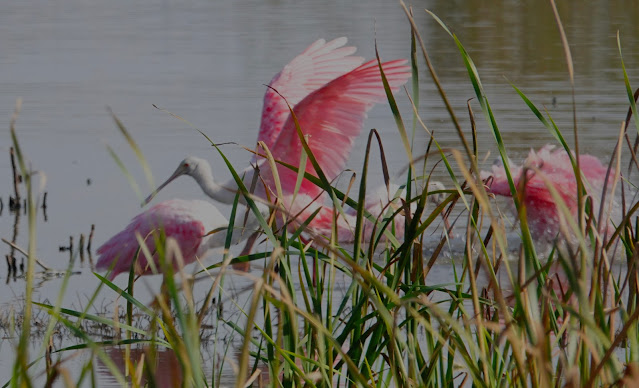
Roseate Spoonbills on Big Slough

Roseate Spoonbills on Big Slough
Showing posts with label Birds of Anahuac. Show all posts

Sunday, January 16, 2022

Visiting a Favorite Refuge with New Friends

 Our Volunteer Village has more than doubled in size with the arrival of two new volunteer couples. My free time schedule overlaps each of theirs by one day. Dee, Steve and I started talking about good birding places and I invited them to join me to visit Anahuac, the refuge where I volunteered while still working and the first refuge I volunteered at when I started my residential volunteer life. 

I further offered to give them the service I used to give people when I volunteered as a free birding guide for Birding Pals. I would bring lunch and guide them. Then we could enjoy a sunset supper at a restaurant on Bolivar Pennisula, along the intercoastal canal before catching the Galveston ferry. 

We had a wonderful day, but didn't even have time to visit all the parts of the main refuge, much less get to the Skillern Unit. But come along.....


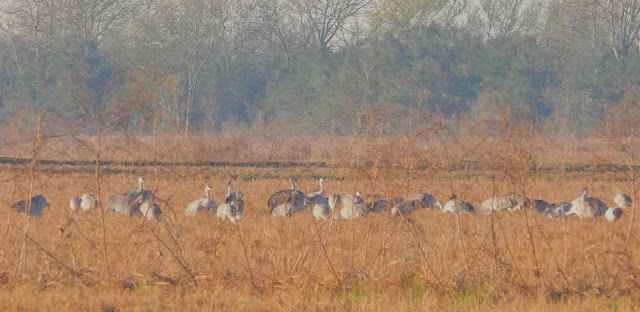
I was completely unable to refind the whooping crane, but we found a field with several groups of sandhill cranes


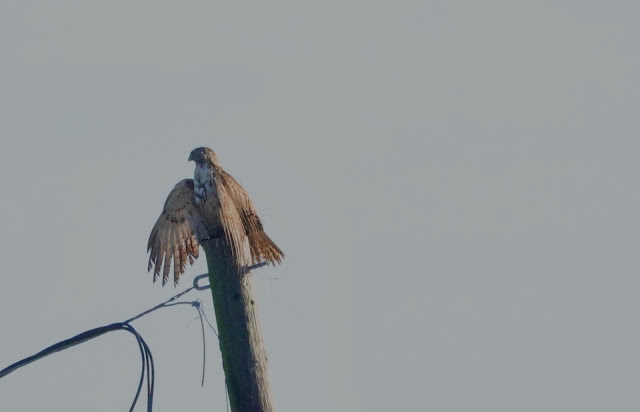
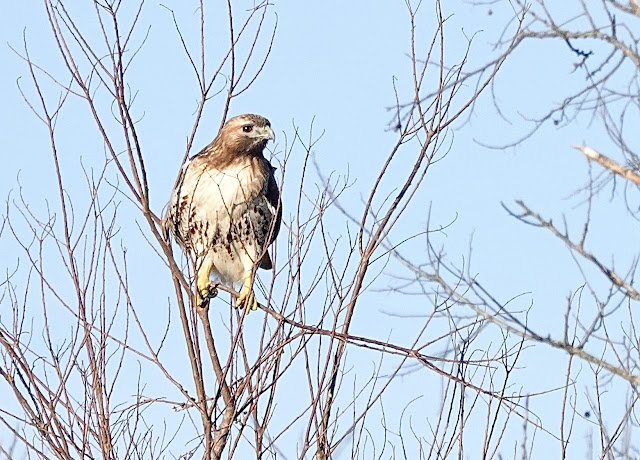
The first bird we photographed was this red-tail hawk warming himself in the early sunlight


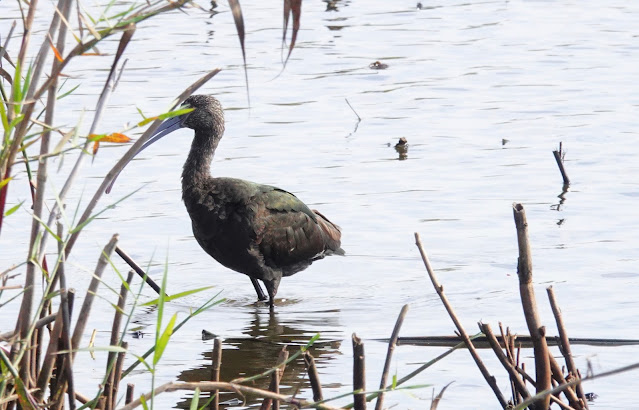
We started seeing lots of white-faced ibis as soon as we started around Shoveler Pond, the auto tour


Many species of birds were hunting together - the ibis' bill is backlit


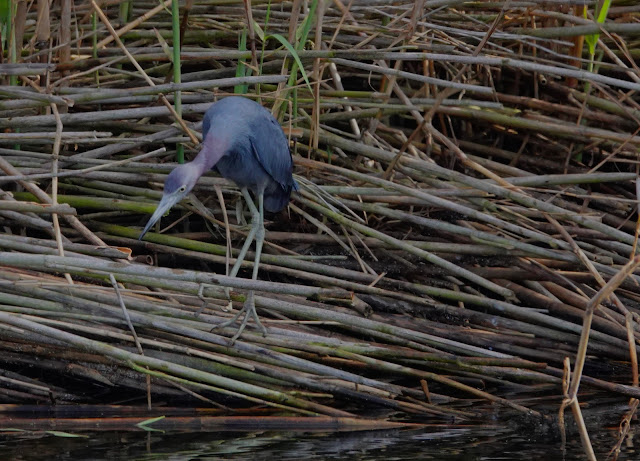
This little blue was with the above two birds, just a bit too far apart to make a good picture


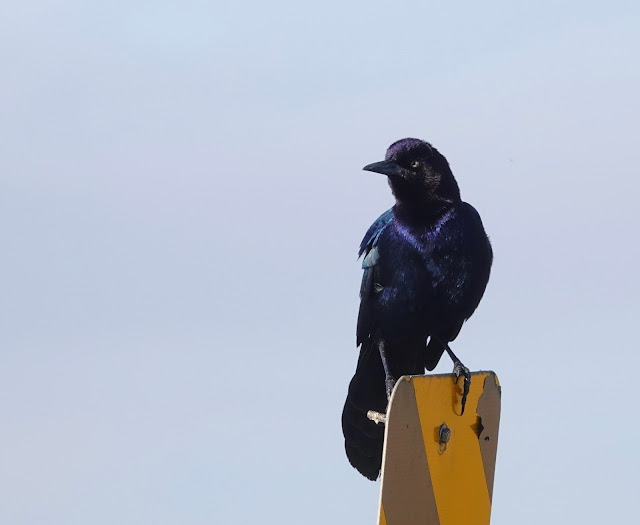
One of the birds people make a particular effort to find  here is the boat-tailed grackle. Dee and Steve could tell boat-tailed grackles from the more common great-tailed grackles with just a few looks. These birds are slightly smaller, have a MUCH rounder head, a smaller bill, and a blue iridescence


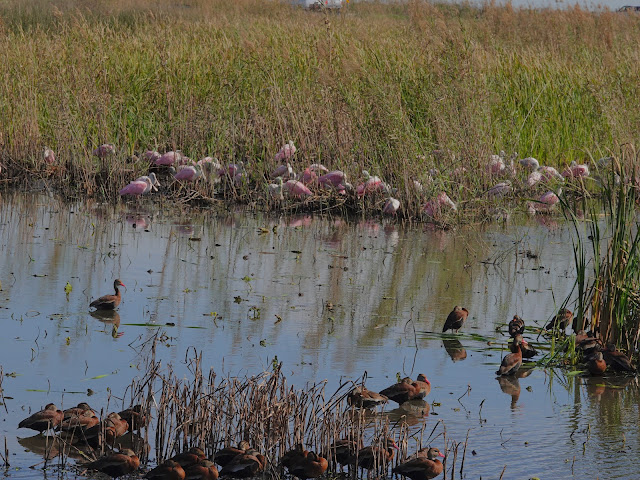
After coots and common gallinules, the two most common birds were black bellied whistling ducks and roseate spoonbills
 

It seemed some of the birds were starting early courting behavior. I'm not sure if this was courting or fighting


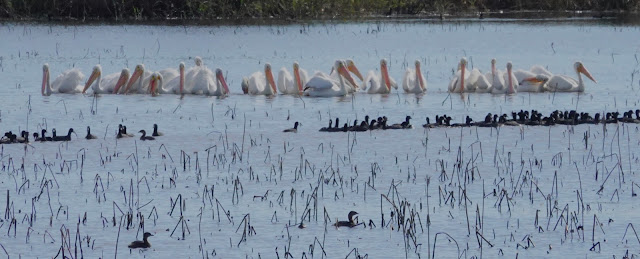
We spent another several delightful minutes watching these white pelicans cooperatively feeding


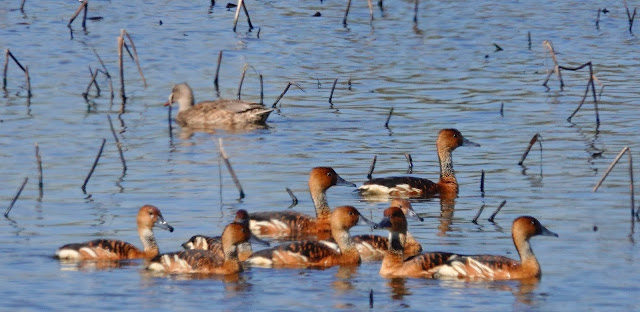
The birds I got most excited about were about a dozen fulvous whistling ducks.  I haven't seen any for over a dozen years.


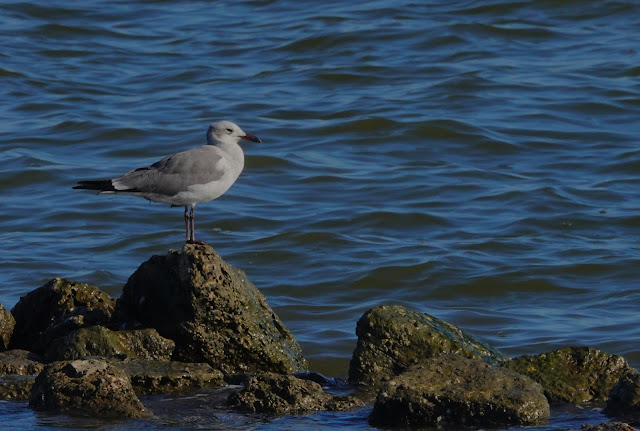
We made it all the way to the end of Frozen Point without seeing many birds, except for a
few hawks. But this laughing gull ...


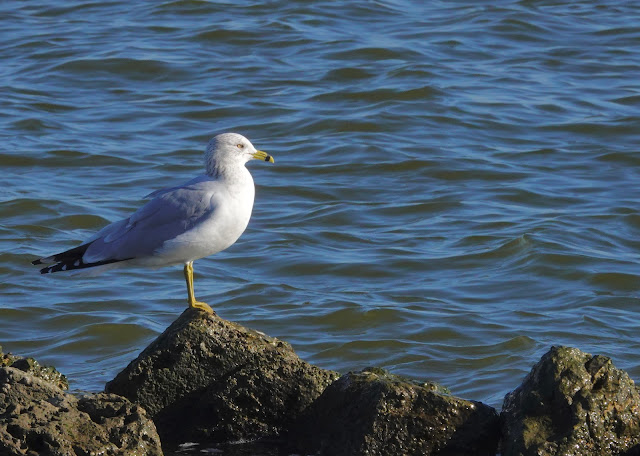
...was hanging out with a single ring-billed gull


We saw several red-tailed hawks but I liked this one's pugnacious expression best


The last time I visited here only a couple of weeks ago, I got to watch several large flocks
 of snow geese and greater 
white-fronted geese fly over. This day, we only saw about
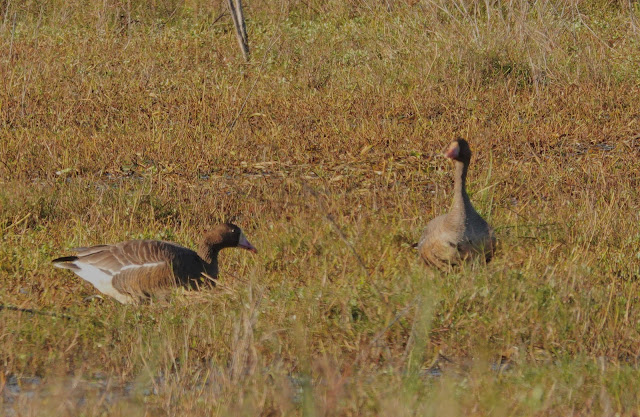
15 greater white-fronted geese on the ground 

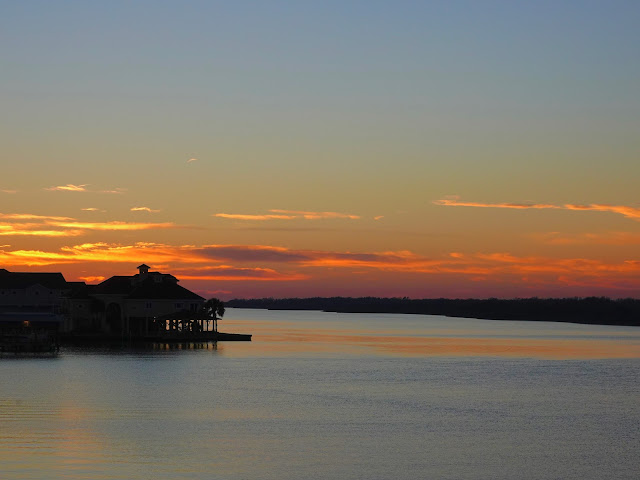
All too soon, and before we could even finish traveling all the roads at the main refuge, much less visit the Skillern unit and do some hiking, we realized, that to take the ferry home and get back about 8:00, we needed to start to the restaurant. When I was last here, Stingeree's, a restaurant that has ALWAYS been here, was closed. I found Steve's Landing which is also on the Intercoastal Canal and only a few miles east of Stingeree's. The food was outstanding, and I figured we could eat outside and enjoy the barges and other boats on the Intercoastal, as well as sunset.  Dee and Steve agreed and we had a lovely meal with  great entertainment.


This shrimp boat came to the marina next to the restaurant

The day was done and so were we


For my eBird list, click here: https://ebird.org/checklist/S100745702


Wednesday, November 26, 2014

Wild Bird Wednesday - A Visit to Anahuac National Wildlife Refuge

On Friday, November 14,  my wrist was healing well from my carpal tunnel surgery and I found I could hold my binoculars and camera, so I could once again visit one of my special places, Anahuac NWR. This refuge is on the Upper Texas Coast and is only a few miles from High Island, one of the top ten birding destinations in America. It is a winter vacation land for geese, ducks, waders, raptors and some passerines, including vermillion flycatchers. The weather also cooperated, giving an afternoon of good light and warming temperatures, between the first two cold fronts of the season.


A hunting great blue heron

Loafing birds - how many species can you find?

The common gallinule seems to be in decline here 

A great blue heron hiding in plain view

Neotropic Cormorant

Great Egret

One of over a dozen pie billed grebes

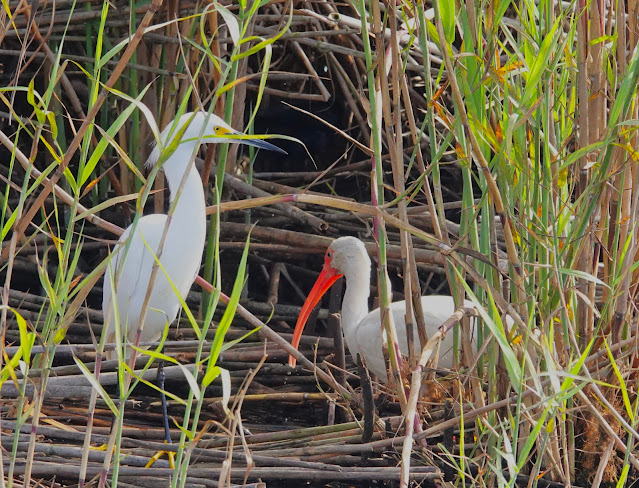
The adult white ibis I saw - but saw over 100 white-faced ibis

A pair of pie-billed grebes were catching the invertebrates the ibis stirred up

There were hundreds of black bellied whistling ducks and scores of these fulvous whistling ducks

Great blue and neotropic cormorants

Swainson's hawk

A western willet showing a hint of his beautiful, patterned wings

The beautiful light on Galveston Bay near sunset


Check out the Gallery at Wild Bird Wednesday


Saturday, June 18, 2011

Secrets of the Skillern Unit

The Skillern Unit is not yet on most birders' rader.  Instead they come to Old Anahuac and visit The Willows, The Butterfly Garden, Shoveler Pond, and the Hackberry Trail. A few look for the seaside sparrows down by the boat launch site on the bay. Some have learned about the great new place, made by the geese, down the road to Frozen Point, where wintering birds could be seen from the road to the levy of Oyster Creek.


Morning on East Bayou

But if one drives another seven miles east, a different set of  habitats appear. The unit adjoins East Bayou and thus has a little riparian area. And it is the area that was farmed for rice before Ike, and now farming has again started which brought in waders, including whimbrels this spring, along with up to 500 fulvous whistling ducks and perhaps 75 to 100 black-bellied whistling ducks. Only two weeks ago, I spotted the last of out winter ducks, a lone male blue-winged teal who was hanging out with a fulvous whistling duck. And it has a huge permanent pond - currently the only water on the refuge, aside from that in canals or the bay.

There are two new handicapp-accessible paths there -one to an East Bayou Overlook where you can get good views of the fields in the evenings.  But the piece de resistance - and my favorite place on the refuge - is the new handicapp-accessible trail to the rookery overlook. "Rookery, you gasp.  I never knew there was such a thing at Anahuac NWR. "  I was surprised to find, that in the four years I hadn't visited Anahuac, a permanent pond had been installed with islands which were planted to attract wading birds.  Hurricane Ike destroyed most of the rookery and lots of the riparian trees but some are still left. (And hopefully, replacing the rookey trees and enhancing the riparian area will be a future Friends of Anahuac project.) A few neotropical cormorants are nesting in the stubs of the trees.  Hundreds of cormorants  and great egrets are using the same area for roosting so I love to go there late in the evening to watch cormorants, herons, and fulvous and black-bellied whistling ducks fly in. And I think a pair of Anhingas are also nesting there. Some cattle egrets are also using the area as a roost. There is usually a flock or two of both white-faced and white ibis to enjoy. A pair of purple gallinules can often be spotted just before the overlook and another one sometimes sits on the same clump of cattail at sunset. Morehens and red-winged blackbirds calls remind me that this is marsh habitat. Boattailed grackles call and skulk to and from their nests in the cattails. This is the only place I find little blue herons. And as the sun sets, common nighthawks peet their fluttering, diving, climbing path through the sky. Two yellow-crowned night herons begin fishing near dusk and can sometimes be found on early morning visits.


Purple gallinule

A yellow-crowned night heron is still fishing in the early morning


White-faced ibis and black-necked stilt


HIDE shrieked the mother then the three little ones hid

And this is now the best place to see alligators. Just walk down the east side of the bayou and stop at the fishing piers. There are also a few alligators in the pond.  I laughed when I saw an alligater make a huge splash and saw a frog jump in a four foot arc above the alligator's head a few evenings ago. Alligator 0, Frog 1.


Alligators come over looking for fisherman that give them handouts


In migration, this was one of the best places to see warblers and vireos. Currently yellow-billed cuckoos, orchid orioles, green herons, scissor-tailed flycatchers and Eastern kingbirds are breeding there. Last winter and this spring I enjoyed many pie-billed greebs, bald eagles, several species of ducks, great flyups of snow geese, flyovers of greater white-fronted geese, and one wonderful flyover of sandhill cranes. Two vermillion flycatchers spent the winter there.


An Eastern kingbird and a yellow-billed cuckoo share a perch


A recently fledgedd green heron

This fall, the wet fields should again attract shorebirds to the fields and the grass path along the bayou will again have migrants and wintering orange-crowned  and yellow-rumped warblers.

So be sure to check out this place when you want to come birding. You can also put in a canoe or kayak from the first pier or  fish from the piers and the bridge. And by the way, if the wind is blowing hard, be sure to listen to the song of the bridge. It plays several tones, all pleasing.  And there are usually a few wildflowers to enjoy.

 .
A beautiful stand of guara

 This is also a good place to look for dragonflies.  A few posed for pictures.

  
Eastern pond hawk


Four-spotted pennant

Tree skeletons against the evening sky

Full moon over East Bayou


.

Monday, February 28, 2011

It Might As Well Be Spring

In, at least the southern half of Texas, spring usually arrives by the third weekend of February and soon we are having our brief spring fling before summer comes in tripping over spring's heels. The signs of spring are growing each day since last weekend.

Pale, hairy legs have appeared, including mine.


Photo by Bob Scaldino. And I'm indulging in my spring compulsion to play in the dirt.

The martins are here - the females also - and are getting their houses ready for a new generation. And  our barn swallows that build there nests on the old Visitor Center are back. I caught them trying to find their nest which was a casualty of the Visitor Center transformation.  


The geese are leaving.  I heard a large flock calling goodby through last Thursday night's fog as they flew northward.


Bye!
 Our harriers have mostly left to start nests in the northern states and Canada.


Bye Harriers!

Tiny new leaves are appearing and flower buds are swelling and even bursting out.

Photo by Bob Scaldino. Our coral vine is about to bloom while waiting to be planted


Photo by Bob Scaldino. Our recently rooted willows are already supporting pollinators


Our Mexican Plums waiting to be planted

Even the redbuds are starting to bloom in their pots

And our alligators are out and eating.  We saw one grab a turtle yesterday. They usually don't eat below an ambient temperature of 70 degrees.


Photo by Bob Scaldino    Sunning alligator.


So, it might as well be spring.

Note:  My friend Bob Scaldino was visiting me.  I made him take pictures while I drove.