Roseate Spoonbills on Big Slough

Roseate Spoonbills on Big Slough
Showing posts with label High Island. Show all posts

Sunday, April 12, 2015

Where Have All the Migrants Gone?

It's migrant season here on the Texas Coast, with lots of passerines supposed to be migrating through our area.  But few migrating birds are being found.  I've been out to many Texas Hot Spots but have only found a few migrants. They are probably flying over us, but we are not even seeing many hummingbirds that usually hang out with us a few days.

I have a friend, Winnie, visiting Natalie and me.  We are all attending workshops and field trips at Galveston's Featherfest.  Winnie and I went off birding for a long day this past Wednesday, before the festival started.

I'm planning to paddle at Sheldon Lake State Park and Natalie decided to also list it as a Houston Canoe Club trip but wanted us to check out the water to be sure it was free of water hyacinths and giant salvenia.  This has a wading bird rookery on ten islands. It also has lots of other birds breeding there like purple gallinules, pie-billed grebes, and anhingas. But there is also a lot of habitat for warblers, buntings, tanagers, and other migrants, so we spent a few hours birding there without finding anything of note, not even a prothonotary warbler, which breeds here.

Winnie is also a Texas Master Naturalist, but was trained on different habitats than was I, since she lives in the drier area of the Central Texas Coast. I knew she would enjoy the restored pothole here. (This land had been a rice farm and a fish hatchery before it became a state park within Houston's city limits. The rice farmer had filled in the pothole to add to his rice-growing acreage. The park located an aerial photograph showing the location of the pothole, then did core studies to locate alien soils.  They removed that soil, and re-created the depression.  Then volunteers, including me several years ago, planted native grasses and forbs in it. )

Winnie reading the interpretive sign about the pothole. 

Spiderwort

A wetland forb and its pollinator

Crayfish must be very happy the pothole is back - their chimneys were everywhere. 

Pickerel weed serves as habitat to invertebrates that ducks love to eat

Black-bellied ducks among the pink primroses
We only saw a few birds but did get a long glimpse into an Anhinga rookery.  

We disturbed a yellow-crowned night heron

We finally got started back to our original plan of visiting Anahuac and High Island.  We stopped by the Office/Visitor Center that is just off Interstate Highway 10 because of the neat juxtaposition of an East Texas mixed forest, a cypress swamp and a reservoir/lake. There is one spot that usually has a breeding pair of prothonotary warblers but none were present. We didn't hear any birds but a white-eyed vireo and a Carolina wren.  We did enjoy a few turtles. 


We stopped to eat our picnic lunch at Double Bayou Park. My most notable birding day there was seeing a field full of perhaps 100 indigo buntings with a few painted buntings scattered about. Today, we saw a vulture the entire time we were eating and didn't hear any calls.

The day was growing late and we wanted to visit both boy scout woods, and Smith Woods at High Island so we skipped Old Anahuac and just stopped at Skillern. We found only a belted kingfisher along the bayou but did find a few birds, including a coot, blue-winged teal, northern shovelers, a couple of roseate spoonbills, one yellow-legs, one white-faced ibis, and one solitary sandpiper.  Again no warblers but the east trail along the bayou yielded a flock of about 20 white-crowned sparrows.

Then we went to Boy Scout Woods. I had to do a count there for eBird so I could count the sulfur-bellied flycatcher we saw there.  (The count was easy - 3 cardinals and one sulfur-bellied flycatcher) Winnie took this picture and it has garnered a lot of excitement among birders. We'll know tomorrow if the tour to High Island got to see it.

A very rare visitor here - sulfur-bellied flycatcher. 
We left Smith Woods for last.  We only walked around the lake, where I saw a
wood thrush and then only rookery birds. We spend about an hour at the rookery enjoying the birds.


Great egret in full breeding plumage, including green lores.  Many are on nests.

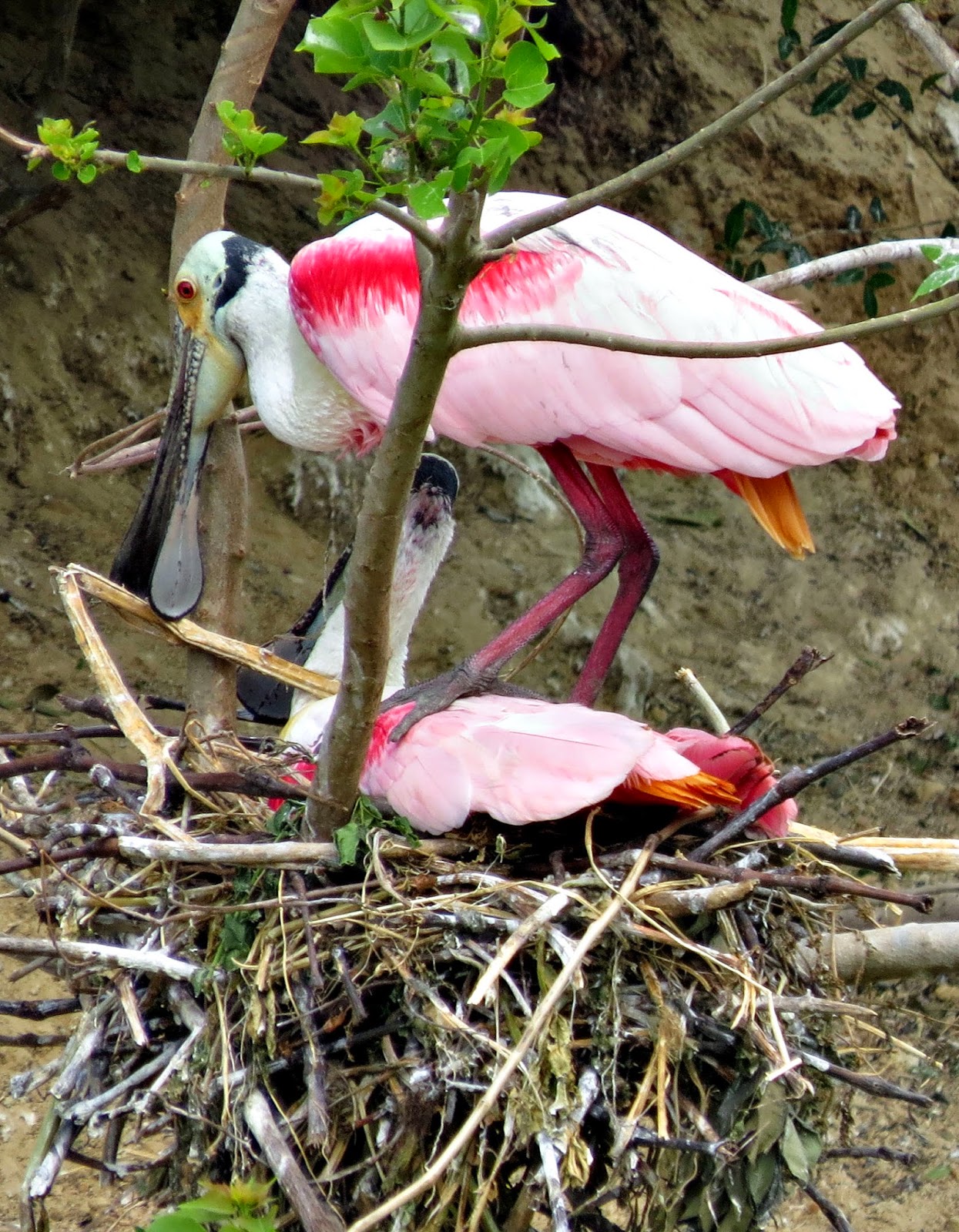
Most roseate spoonbills are only hanging out but a couple were nesting. 

Winnie spotted this alligator up in the trees in the rookery he'll eat well when older siblings kick younger ones out of the nests

Little blue herons are just beginning to appear

Strange companions

Tri-colored herons are also beginning to show up - think more of them are on the back part of the island
We left with enough light left to go look for the little and Bonaparte's gulls that had been hanging around together. But there was a lot of human activity on the beach and we saw no sign of them. But we did see the common visitors, - laughing gulls, sanderlings, ruddy turnstones, and willets.


A very handsome willett

Then we stopped by a very popular restaurant that is right on the ship channel and were there when the sun almost came out of the clouds and gave us this view.  We went to take this picture - and lots more, of course - between our salad and entree course. We came back to find our table cleared and new people being seated there. But we soon got new drinks and our entrees.


Returning fishermen
Winnie and I had a good day, even with limited numbers of birds to see and photograph. And we got an unexpected lifer.

I'm going to be blogging sporadically from now to mid-May.  I'll be camping and visiting friends, paddling, and birding and then rushing to leave for Montana. I should finish my migration May 11 and be on my summer grounds, Red Rock Lake National Wildlife Refuge.  

Wednesday, May 14, 2014

In the Pink: The Lives of Spoonbills

I recently visited the wading bird rookery at High Island.  In the last few years, there have been more and more roseate spoonbills competing for nesting spots with great ,snowy, and cattle egrets and neotropic cormorants. 

I drove into the back entrance to this Audubon sanctuary, then walked along a path that went under a tunnel of trees before reaching steps that lead to the raised edge of the lake. Shrubs have grown up in the last few years, since Hurricane Ike destroyed a lot of trees here and the path along that levy is mostly behind shrubs.  But the Audubon Society has built several viewing platforms so you can get many perspectives on the rookery. 

The sound and smell of thousands of birds hits you first, then you get to a viewing spot and see one end of the rookery.  It is on a horseshoe-shaped island .  Both arms could be seen in the past, but now the back arm is mostly screened from view by the shrubs growing on the front arm.  As you move down the path along the lake, you get closer and closer to the birds, until you are only about eighty feet across the lake from many of the nests. 

I love roseate spoonbills and, over two visits, one a couple of years ago, I had many roseate spoonbill pictures, so I thought I'd share the lives of these beautiful/ugly, graceful/clumsy, birds.  I really admire their fashion sense.  Who else would wear hot pink with red, orange and yellow?  Even guy spoonbills wear these colors with panache. 


A small piece of the rookery at Smith Woods, High Island, Texas

Life in the rookery is chaotic with birds flying in and out, birds feeding in the water at the base of the trees, birds fighting, having sex, resting,  collecting sticks, or just hanging out. When the chicks hatch,  the action gets even wilder. Spoonbills do a little courting but I'm not sure which actions are part of the courting ritual.  The males bring in sticks and then both seem to decide where to put them.  I saw some males bring sticks to females already sitting on eggs. 


There are frequent chases and confrontations, that usually don't get to the physical stage

An altercation with a snowy egret

Feeding peacefully

Snack time

I couldn't find my picture of it, but a few years ago I heard the sound of sabres rattling.  I looked toward the sound and saw two spoonbills fighting over a stick.  One went after the other with his bill and the second one blocked back with his own bill.  Then they shook their heads and rattled their bills until one finally gave up and left the stick to the victor. 


These guys seemed to be each trying to break a stick off the larger branch


This bird was trying to find a stick

And this bird brought a stick to the nest


Hanging out - picture taken two years ago and this tree has fallen down


They look their best in flight

Both pairs share nest duties but often one bird is on the nest and the other is standing nearby.  The bird standing around often chases off other birds. 


Chasing off a rival?


Beginning of another altercation

Birds often land at the very top of a shrub or tree - is this part of their display?


Both mates are often together with one on the nest and one standing nearby

There is NO privacy

I have yet to be there when I can get pictures of the babies. But if you live in the area, there should be babies you can visit in two or three weeks. Great egrets already have babies and some snowys are sitting on eggs. The light is best after 4:00 P.M.

Click on the picture to read many more blogs about wild birds.


Tuesday, May 6, 2014

Birding Trip to Bolivar Peninsula and Anahuac National Wildlife Refuge

Natalie and I wanted to go to Anahuac NWR to look for migrating birds and visit the new visitor center, finally built to replace the one lost to Hurricane Ike.  While we were in the neighborhood, we planed to do a little birding on Bolivar Point, Rollover Pass, and High Island, which is one of the top ten birding hotspots for migrating birds. We left around seven and caught the free ferry that runs from Galveston Island to Point Bolivar.  We got out and enjoyed the common birds, laughing gulls, a few terns, brown pelicans, and some neotropical cormorants as well as a few porpoises.  I had hoped to see magnificent frigatebirds, but I guess it was too early for them.

Shrimp boat with its bird entourage 

We stopped at the lighthouse pond and found blue-wing teal, pie-billed grebes, great egrets, and mottled ducks. Across the street, in the  ponds behind the concrete structure, were some plovers and sandpipers. We stopped at Fort Travis to see if we could find a lingering vermillion flycatcher, but only found boat-tailed grackles, ruddy turnstones, lots of black-bellied plovers in various stages of molt, one snowy egret, barn swallows, one least sandpiper and a huge mass of gulls, terns and  brown pelicans, all too far to see much of but one marbled godwit did get (barely) close enough to get captured by my camera.


Ruddy turnstone in his courting outfit


Marbled godwit

Black-bellied plover in spring molt

Grackle version of a pissing match
 We managed to miss going to Bolivar Flats Shorebird Sanctuary, which has the best viewing light in the morning, as well as several other places along the way.  We really needed at least two days to visit all the bird hot-spots along this route.

We did get to Rollover Pass where the best birds were avocets, black terns and skimmers.  All but one avocet were too far away for pictures.


We stopped at Boy Scout Woods at High Island but the birding was slow and the birds high in the trees.  We skipped Smith Woods, which has a rookery for all kinds of wading birds Neotropic cormorants and Anhingas - I'll go back there soon and hopefully have baby pictures to share.

Our first stop at Anahuac was at the old Visitor Center, now rebuilt into a shelter/blind.  We ate lunch while marveling at how the cliff sparrows have displaced the barn swallows who traditionally were the only species to nest here.  There were only two barn swallow nests but probably twenty or more cliff swallow nests.


We walked through the butterfly garden and down through the boardwalk to the willows.  White-crowned sparrows were the dominant bird in the butterfly garden area. But in the prairie area and down through the willows, there were lots of eastern kingbirds. I think they had just arrived and not yet dispersed.


White crowned sparrow foraging


Eastern Kingbird

Down near the Willows, we found this juvenile yellow crowned night heron still mostly in his spotted brown feathers.


Usually there are lots - as in scores to hundreds of common gallinules on the refuge - but we only saw less than a dozen. However we did see several purple gallinules, another surprise. They are usually in smaller numbers and harder to find.  And we were birding in the mid afternoon by this time, so many birds were out of sight.


We spent a lot of time at the start of the boardwalk into Shoveler Pond, watching this prothonotary warbler foraging close to the water only a few feet away.  Not sure why he has the orange on his head. (Later I found he is probably a hybrid - with a south American cousin.)


And we spent a few minutes watching this neotropic cormorant pop up with a fish and then maneuver it into the head-first position to swallow it.


We heard lots of marsh wrens but never saw one climb high up the reeds enough to see it. But coots and common gallinules were swimming close to the boardwalk.  Lots of orchard orioles and red-winged blackbirds were also in the reeds.


We went to the Skillern Unit on the way home but it was almost birdless. Along the paved walkway, we only saw a few more hens and coots.  We did see this female ruby-throated hummingbird. 


But when we went down the fishing side of East Bayou, we found lots of indigo buntings, a yellow warbler, more kingbirds, and a small flock of northern rough-winged swallows. 

For all you birders out there, if you haven't birded Texas, check out our Great Texas Wildlife Trails maps and start dreaming. Here is the link that has descriptions of the places we visited and those we missed. Texas has three maps that take in birding trails along our coast and another four that cover inland areas.  In migration, each site can be different each day, and even different between morning and afternoon.  So no matter, how you plan your trip, you'll hear what you missed by not being somewhere else.  And you can get seventy species or more in a day without working.


Click on the picture to go see birds from around the world.