Roseate Spoonbills on Big Slough

Roseate Spoonbills on Big Slough

Saturday, October 12, 2013

Palo Duro -Texas' Grand Canyon

"It is a burning, seething cauldron, filled with dramatic light and color."

So wrote Georgia O'Keeffe who lived in nearby Amarillo and Canyon, early in the 20th century and visited and painted Palo Duro Canyon.  It  still is filled with drama, mystery, light and color. 


 Fortress Cliff
I arrived at the Park after stopping in Amarillo, TX for a really delicious Thai dinner.  I never found the packet left for me by the staff, but I did know that I was at site 70 in Cactus.  After about an hour of wandering around in the dark I found it, shortly before the beautiful crescent moon set, allowing the sky to become crowded with stars.  The night was so hot, I decided to just sleep in my hammock.  But the mosquitoes there so hungry, that they were willing to sample me, so I didn't get much sleep.  I finally fell asleep around five o'clock and then didn't wake up until eight.  I had to go back and finish registering, so quickly made some coffee and started out.  It took me almost two hours to make it back to the office.  Then I kept taking pictures until the light was way too harsh to save them through editing. 

Because I arrived in the dark, I missed the wonderful feel of looking across a relatively flat prairie, then driving down inside the canyon and finding myself in the mountains. This wonderful canyon has some of the same clays, and thus the same colors and formations of the John Day Fossil Beds, in Oregon.


Moon upon my arrival at my campsite


Canyon Walls

Decorated hill

Lonely little hoodoo

Asters

These small formations almost looked like they were boiling out of mud but were rocks

e
Not everything here is clay


Beautiful Spanish skirt formations

Just me and my shadow - one of my camp visitors


Possibly my favorite formation
A long view up into the canyon

More skirt formations


Another camp visitor

Natalie and I may the only two paddlers that can claim to have paddled the Prairie Dog Town Fork of the Red River. Mostly it is just a tiny, muddy stream, only suitable for toy canoes.

View from one of the low water crossings

Often flash floods fill the canyon floor and make the stream leap out of it's banks while hauling an extra load of clay. There are five low water crossings on the main road and one more on the side road. These become impassible in the floods that change the tiny stream into a raging slurry of red mud.  Many years ago -  I can't remember the date but it was 12 - 14 years back - I joined Natalie on her vacation.  We planned to spend several days at Palo Duro Canyon and got a campsite that required us to cross the river three times.  Our second morning there, we packed up a lunch, put the two dogs into their crates after giving them food and water, and left to go to the Pandhandle Plains Historical Museum. (This should also be on your bucket list.) We  were totally engaged most of the day, only coming out of the museum to eat a picnic lunch under  sunny skies.

One of the low water crossings

 But when we reached the park, a ranger told us we could not go back to our camp, because the crossings were impassible from a rain many miles away.  Fortunately, we had my canoe on top of the van, just in case we found a place we just had to explore from it. And we also had Natalie's daughter, Suzanne, who helped our negotiations by crying for her dogs.  

After we persisted in insisting we had to rescue our dogs, we agreed not to sue the park if we damaged ourselves, and the ranger agreed not to see us canoeing, and allowed us to proceed to the first crossing. There we unloaded the canoe, put Suzanne in charge of her sister, Ellen, and set out. The crossing was only about two and a half canoe lengths wide, but the paddling sure felt funny, pulling a paddle through that red slurry of mud.  And when we stepped out of the canoe, we stepped into knee high mud.  We looked like we had  red knee socks on for a few seconds until the mud sloughed back off. 

We had to carry the canoe about a quarter of a mile to reach the second crossing. When we made it across that crossing, we found a group of people stranded in their camps.  One guy watching the crossing had a truck and offered to haul us to the third crossing. So Natalie and I climbed in back of his truck and held my eighteen foot Kevelar canoe down in the truck.  

By the time we paddled across the third crossing, we were pros.  We landed and  walked to camp where we gave the dogs water, then packed up their stuff as well as clothes for us. Then we packed everything back into the canoe and returned, again getting a haul in the back of the pickup. We went to Amarillo and rented a room in a motel for the night.  The next day we had to wash our clothes before returning  to the park the following evening. We moved our campsite to the first camp, which is before the first river crossing so we would not be stranded again. 

I was reminded of this incident when I saw the Texas Department of Transportation scrapping clay off the river crossings and hauling truckloads of it away. The 6th river crossing was still closed but had lots of prints of animals who had visited there, including bare-foot humans. The mud was at least a foot deep there.


Raccoon was here


Map of the canyon in the visitor center

 Designated as a protected State Park in 1934, this canyon is the second largest canyon in the U.S. next to the Grand Canyon. Measuring 120 miles long, 20 miles wide, and a maximum depth of more than 800 ft., Palo Duro was formed by water erosion from the Prairie Dog Town Fork of the Red River while sediments being carried by the water deepened it. You can experience the canyon by hiking one of the park's comprehensive 30 miles of trail, riding horses, camping, or taking a scenic drive.

All these pictures were taken from my campsite or the road.  But I did have time to take a short hike up the Rock Garden Trail.  I was running out of energy and daylight and didn't finish it but I did get to the most beautiful part. I'll have to edit several  more scores of pictures before I show them to you.

I have the total set of pictures from this tour here.

Wednesday, October 9, 2013

Preview of My Next Summer Home

One of the things that Bob G. and I did, while traveling to Minnesota, was to spend an afternoon and night at Red Rock Lakes National Wildlife Refuge, where I'll be working next summer.  One of the neatest things about it, is that there are two primitive campsites there. (So lots of you can visit - I'll feed you.) Bob and I chose to go to the most open one because it was near to a lake full of birds. And also because we knew there were a few campers at the other campground.  But we visited the other one the next morning,  and found it has a natural spring with delicious water. Another neat thing about the refuge is that it is less than 50 miles from Yellowstone, so I expect to spend a lot of time in Yellowstone.

Entrance

Although the weather was very cloudy, we could see that the refuge is in the bottom of a bowl and has lakes, ponds, and fields.  The landscape is not as dramatic as National Bison Range, but I think it supports more species of animals.


A view on the way into the refuge

This large grove of aspen looked like a good birding spot

 This place is a birder's paradise because one of its missions is to provide habitat for trumpeter swans.  So all kinds of other water and wading birds nest there.  You'll find out more about this when I do, after I start doing my bird surveys and my  recreational birding. And if there is enough water - not the case this year - one can paddle from the upper to the lower lake.


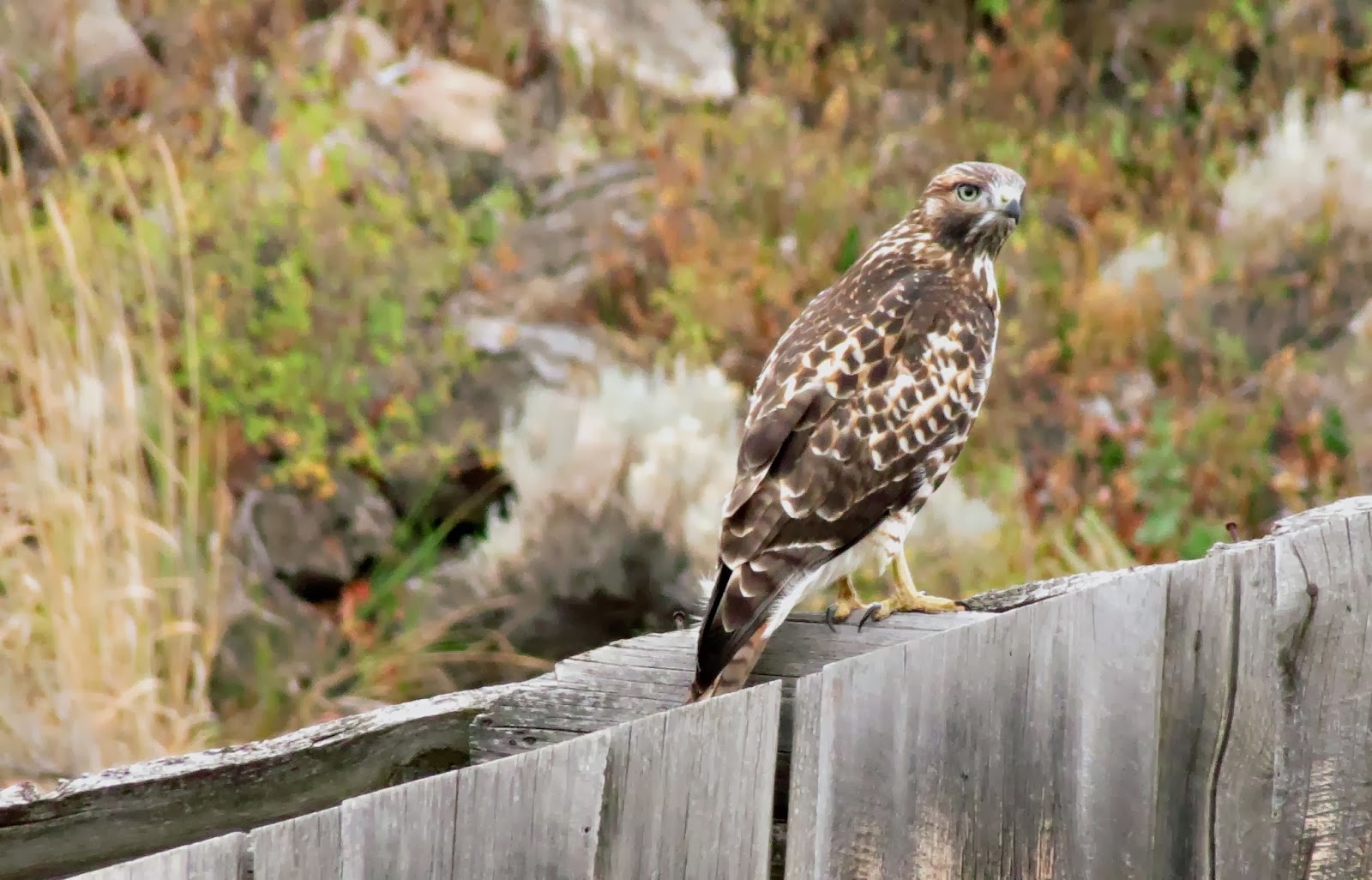
An immature red-tail hawk who was probably born here

Sandhill cranes were calling from all directions


We saw lots of ducks and several swans but most were too far away to photograph

By evening,  threatening weather improved and gave us an outstanding sunset.  While the landscape is not too dramatic, the sky goes on forever.


Sunset coloring the storm clouds

Reflections of sunset


Bob walking around in the evening light

This is a remote refuge, and seldom visited so doesn't have a large visitor center. But it does have some interesting displays in the office.


Entrance kiosk with office building in the background

The immediate area has a series of buildings that look like a little town but are really part of an institute.

One of the store-front buildings with animal banner

The next morning we explored a little more on our way out.  We had much prettier weather, starting with a gorgeous sunrise.


Early morning sun on water adn birds

Hills across the lake with reflection


Bob looking at the lake from the other campground


This formation looked like a mostly buried mammoth dinosaur

I'm looking forward to getting to work with the birds and doing my other jobs there. And I'm probably going to get involved in drying food, since I have to drive about 120 miles for groceries.

This blog will come out while I'm traveling back to Texas to visit friends and family, get several paddling fixes and a little gardening fix.(All are events are canceled here and I won't even get to say goodbye in person to most of my co-workers.)  I'm planning to play a day at Palo Duro Canyon State Park, in the Texas panhandle,  so that will be the subject of one of my next blogs.


Friday, October 4, 2013

Breakout!

By yesterday, Dave, a Law Enforcement Trainee, and me, the only current residents of the bunkhouse were both climbing the walls.

Our exciting, interesting experience had gone way south and we both felt like prisoners.  Dave much more than me, because I, at least, have my own vehicle while he is driving a government vehicle and can't use it for personal trips. But both of us are confined mostly to the bunkhouse while on the refuge. Dave also has been away from his family because of this training and was looking forward to spending one night with them, while traveling to Missisippi.  But he has been locked in to here, while the refuges are shut down.

I decided enough was ENOUGH, and invited Dave, who was on days off,  to go with me on an outing. (Law Enforcement people are still on duty to protect the refuges.)  The ground rules were that we were going to head west to Thompson Falls where there is a place where big-horn sheep are easy to spot. Other than that, we would stop as often as either of us wanted, and go wherever we decided to. And it was already a given, that we would discuss our situation or make guesses as to when we could be normal again. So we packed food, water, extra clothes, binoculars and camera and got around to leaving about ten, after waiting to see if the weather was going to cooperate. 


 We only had to take Highway 212, to 200 and head west. Highway 200 is described, correctly, as a scenic highway. We went through the tiny town of Dixon and soon were traveling through a beautiful valley built by the Flathead River, with views of a few high mountains dressed in new snow veils. The air was cool, crisp and blown about by a north wind.  Just getting out of the car to take pictures or scan for wildlife started the rise of our moods.


Highway 200 view looking south early in our trip

And the view looking north from the same scenic pullout


I had to climb down the bank a little ways to catch this bank of blooming rabbitbush

 At one stop, Dave found at least 100 big-horned sheep and lambs.  They were so far away, that, when I zoomed in took the picture, then enlarged the picture in my camera, I could still barely tell what they were.


Some of a huge herd of big-horn ewes and lambs

Another view of the Flathead River from a fishing access point

 Just before we got to Paradise, the Flathead River ran into the Clark Fork River, but the road mostly continued to follow the Clark Fork River, on one side or the other. So, the scenery remained gorgeous with only the name of the river changing. We stopped at one river access point, Pair-of-Dice which is at the edge of the town of Paradise. For a moment I was transported to the Hill Country Area of Texas by the sight of a long-horned cow. It even had the don't-fence-me-in attitude that we had - it had gotten out of its pasture.


Longhorn

View of river after it crossed the road

We continued through Plains where I decided to go visit the Lolo Forest Ranger Station until Dave reminded me they also closed by the government, so we would not be able to get any information on hiking.  But a few miles further, we saw a forest road that looked intriguing and we both agreed we'd like to travel it. We wound upward through a mostly evergreen forest of pines and spruces.  We came to an intersection with a sign leading to a fire tower and both wanted to visit it.  But my little Honda Fit didn't seem up to the narrow, muddy, tracked road so we bypassed it and continued upward.

Right on the top, we crossed a trail and decided to park and walk it. We took it until we found another road, then walked that road, plus a logging trail back to our trail, and shortly after, to the car.  Both of us really enjoyed the activity and the new views.  We only hiked about three miles but what a vast improvement  it was over our bunkhouse lives.


View on our hike - think the snow-covered mountain is Old Baldy

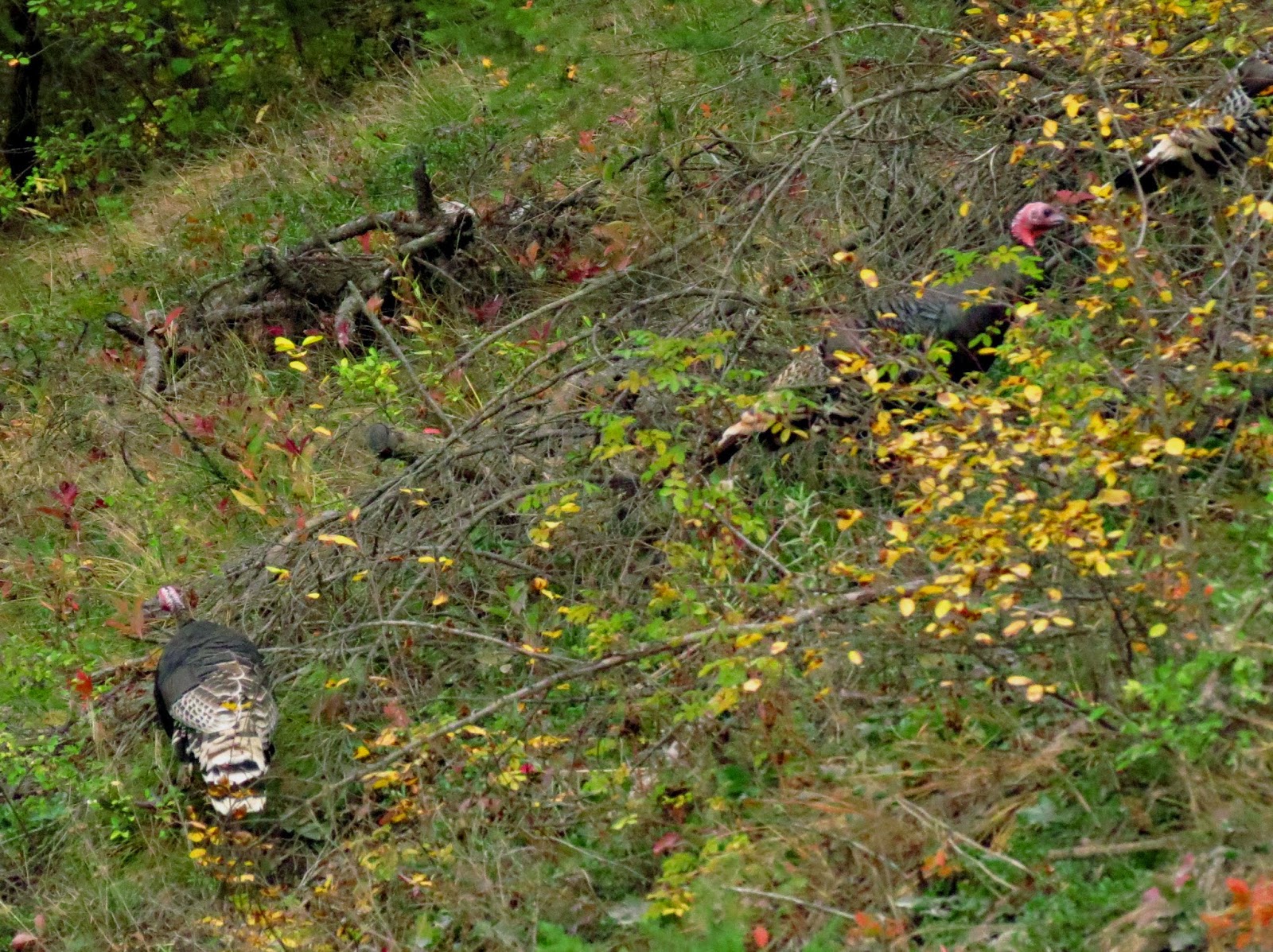
 I had expected that the road would take us near to Thompson Falls but I think I took the wrong turn.  We finally ended up back in Plains after winding down and around the mountain, and had to travel a few miles of Highway 200 that we seen earlier.  We only had to stop once, to watch turkey's crossing the road.


A few of the flock of about twenty turkeys we found in Lolo Forest

It was mid-afternoon before we reached the pull-out that is the place to sit and watch for big-horned sheep.  We didn't see any, either time we stopped, but did see a pair of ewes grazing between us and the railroad, which runs along the river. The railroad was fenced off here to protect the sheep.  The road had lots of warning signs to watch for the sheep in the road.

While driving around in Thompson Falls, we saw a sign for the Jailhouse Museum.  We both decided to go there, but then our eyes reached a sign hung on the bottom which said, "Closed for Season".  We stopped in at a gas station for coffee and asked the lady there if there were any interesting walks in town.  She suggested we go walk the island and see the dams that provide power to the area.

So we drove another block, made a left turn, and found the parking lot.  Then we explored the trails that led to the high dam and the fish ladder, a bridge built to haul materials to build the dams, but which is just for pedestrians now, and the trail to the low dam and powerhouse. There was lots of signage explaining how the dams worked and how the fish ladders were later installed at the cost of several million dollars to provide access to fish swimming upstream to spawn.


The High Dam


Fish Ladder - Fish zig-zag up through it to the high lake.


Interesting rock outcropping on the dam island


View of the low dam and the powerhouse

We left Thompson Falls and decided to come home by a much more roundabout way that would have involved us going north and east to Poulson, and then coming back to the refuge. But about the time we got to Hot Springs, Dave remembered he needed to be at the bunkhouse in time for his wife to call him.  So we turned around and started home  by the shortest route.  This took us by Rainbow Lake and we decided we could spend a few minutes there. Before we had gotten out of the car, we spotted an eagle who seemed to be trying to sit on a limb, and look for a fish, but was being blown about. Then we enjoyed a short walk along the lake before driving home.


Eagle at Rainbow Lake

We came back in great moods, and were so relaxed, we both slept longer than usual.

Now, the following morning, I'm about to go vacuum my car, then pack in everything I can live without for the next few days.  I am expecting to be able to make the decision to leave by Monday night or early Tuesday morning. As soon as my bosses decide that we won't have the time or manpower to have the Big Sit, even if we reopen by October 9, I'm going to leave.

One of my mottoes is" If it ain't fun, don't do it."  Here, I'm neither having fun nor feeling of any use. So now I'm dreaming of visits to friends and family and lots of paddles.


Tuesday, October 1, 2013

Boundary Waters Bob, Our Hero

We started our Boundary Waters Trip with two mules, I mean guys, that did all the boat hauling and most of the food box hauling, as well as carrying their personal packs.

Natalie and I carried our personal packs, and usually carried the guy's day packs when we were moving to and from a campsite. On day hikes, we only carried our day packs, while the guys took care of the canoes and also carried their own day packs.

Our fire pit/ dining area at our camp on Caribou Lake
We came out after five days  of paddling and stayed one night back in the bunkhouse. Bob had to leave about midnight to get Andrew to the airport in Duluth. But we all were dreaming of a big steak, so we took a shower, let Andrew get his gear packed to either take on the airplane or send home with Bob, then drove to Trail Center, a popular, little restaurant nearby.  Natalie had to protest that she couldn't possibly eat an entire 16 oz steak before diving in  and cleaning her plate. .  The rest of us didn't bother but all were able to clean our own plates.  Bob and Andrew even had room for desert.

A waterfalls connecting two lakes


Easy rider - several times we had dragonflies ride along on our arms
The second week, poor Bob was stuck with hauling a a three-man, 21 foot canoe.  This one weighed 55 pounds and was so long, that occasionally he had difficulty making turns on the portage trails. He was such a guy, that he hauled BOTH his personal pack AND the canoe, which made a total of at least 100 pounds.  AND he suffered both of us picking on him.  

Interesting ground cover with fruiting bodies -  about 8 inches tall
 But I must say, he is one of the kindest and most amiable persons I know.  He is always ready to take care of people and sees the job that needs doing and jumps in and does it. He did a wonderful job of planning this trip and taking care of Natalie and me.  And he is always ready to take any abuse we hand out.  Once, on another trip, he fell over backward when his chair sank into a sand bar.  He even recreated his fall so we could take a picture of his disaster.  AND he was STILL speaking to us after dealing with us over almost two weeks.

At each portage, helped  unload all the gear, then put on his personal pack.


Then he got balanced - usually on some rocks, and  picked up the canoe.


 Then he swung it up and over his head.


And then, he rock-hopped to the trail.


And then it was  up and down hill, sometimes slipping through muddy spots.

 Some 30 to 100 rods later, he'd be ready to again hop across rocks to put the canoe back in the water, and reload it.

Meanwhile, Natalie and I only had to carry our personal packs, our day packs, and usually Bob's day pack.  He carried our food pack for his second load. I'm sure he was really glad he didn't have do this every day, but only on the way in an out.

We again did day paddles and explored more lakes. One of the neatest plants we found were pitcher plants.  I had never before found them in the boundary waters.


We had much better weather and early morning sun on our campsite. Our favorite place from the time we woke up until way after breakfast was the rock right by the water.  It warmed up as soon as the sun came up, and the winds were blocked by tall shrubs. We enjoyed the flight of birds past our site, swimming loons,  and visiting with passing paddlers. We were so laid back, EVEN ME, that we often didn't leave to go paddling until almost noon.


Then we would come back and I'd quickly add water to my prepared and then dried meal and call them to come eat.


Supper's on
Then we would sit again to enjoy Bob's fire until we could not longer keep our eyes open.

Ready to burn

I suggested that Natalie might like to spend a couple of days enjoying Ely. Must-dos there include eating at the Chocolate Moose Restaurant, browsing through Piragis's wonderful store filled, with camping supplies, gear, clothes, and books, visiting other stores that cater to outdoors people, visiting the International Wolf Center, the American Bear Center, and the Dorthy Moulter (AKA the Root Beer Lady) Museum.

Natalie  was delighted to get to go to a place she had heard so much about so we came out of the Boundary Waters on Wednesday night, stayed yet another night at the Rockwood bunkhouse, then drove the 90 miles to Ely.  (Crows can make it in about 30 miles over the road-less Boundary Waters, but we had to to south, east, then north by road. We arrived in time to thoroughly enjoy the American Bear Museum.  This place reflects over thirty years of bear research in the Boundary Waters and has lots of videos researchers have taken of bears, as they often follow them around. Take time to look at some of the ones shown on-line from their web-site.  We ended up spending about five hours there, with a break for a delicious lunch at the Chocolate Moose.

We all enjoyed our day and a half in Ely.   The following day, Bob and Natalie went to the International Wolf Center and the Dorthy Moulter Museum.  Natalie was thrilled to see both and both of them had lots to tell me about their day.  (I stayed at the motel and worked on editing pictures and writing blogs, then did a little shopping and took a long walk on the Mesabi Bike Trail, before cutting back through town to meet Natalie and Bob for supper.

Natalie's photo of two happy campers
I also really want to thank Mike and Lin at Rockwood Lodge and Canoe Outfitters for the great equipment wonderful hosting, and great advice. And just gotta say that Trail Center Restaurant was also a great experience.  (Actually about four wonderful experiences, including breakfast, lunch, and dinner.) The restaurant also makes its own dried food to take with you.  The samples were really delicious.

I'm finishing this blog on October 1, 2013, a dark day for all the employees of National Parks, the Forest Service,  U.S. Fish and Wildlife, The BLM, and most other federal employees who have been furloughed and will be locked out of their jobs by noon today.

I'll get to stay here, but we will not be able to have Roundup if this goes on more than a few days, which is when we remove enough excess animals, so that the herd can have enough food to live through the winter. This could have serious consequences on the health of the herd over the next several years.  And I have no place to play since I usually am recreating on public lands. I can't even drive around on the refuge.

And the saddest thing is that the people I work with have chosen to work in low-paying jobs because they want to help keep native plants and animals and wild, beautiful places available for the enjoyment of people, as well as the health of the planet and now they will get no money as long as the government is shut down. One of my friends just started her first permanent job and now will not receive any pay.  Please pray for them and their families and for our country.