
April 3, 2016
One of the places my daughter, Kim, suggested visiting while I was at her house, was Fallingwater. It is the only house designed by Frank Lloyd Wright that is intact and complete with the Kaufmann family furniture, pictures, and other artifacts. Time magazine called it Wright's most beautiful work and and the Smithsonian has listed it as one of the Twenty-Eight Places to See Before You Die. I had attempted to visit it about eighteen years ago, but arrived on a day it was closed and I was only able to access the grounds. So I was excited to go.
We had about an hour and a half to drive to get to it, and while we were driving, we ended up in heavy snow. But the snow stopped and the day was partly cloudy with the sun and clouds fighting for dominance, making for difficult shots. We reserved a tour, then found we could switch to an earlier tour, so only had to wait about twenty minutes. Originally, I had wanted to get there early, and photograph around the site, but when the weather was so cold and the day predicted to be partly cloudy, I planned to mostly photograph after the tour.
Soon our tour number was called and we went to meet our guide and group, which mostly consisted of young Asians.
The tour guide collected us just before the bridge over Bear Run Creek and told us that we would not be able to take any photographs inside the house. So you will have to go there for yourself to see the fabulous interior.
This house was designed to blend and complement the area it was in and the habitat, especially the creek and waterfall, was incorporated into the house. The house is built of rocks to mimic the rocks on the ground and also in the creek bed. The floors are waxed to look like underwater rocks, while the stacked rock columns are left "dry". There are places in the house, where the natural rock outcrop rises from the floor. There is a hatch area, made of framed glass, in the living room which can be fully opened to the sight and sound of the creek. And the family could walk down the steps directly into the creek. All the bedrooms have glass walls and windows that can be opened to hear the falls.
The house interacts with those moving through it. This was especially apparent in the downstairs bedrooms where you come in from a narrow dark hall to the very bright rooms that have glass walls. The ceiling also comes way down as you come into the room, forming a very comforting level above the open wall. The colors are very simple and organic. The walls are light ochre throughout and the trim is Cherokee red. Even the built-in couches and occasional tables were designed by Frank Lloyd Wright. The kitchen, however, was not designed by him because he considered it only a work space. I think the family and their cook designed it to the cook's taste. (And by the way, the cook is the last person still alive who lived in the house - she is 102.)
We ended the tour in what used to be the garage for the house and which held up to eight cars. Now I think only part of the original garage is roofed and it has been converted into a movie theatre. We watched a two minute film about the house there.
After the tour, we wandered around the grounds - and we had a lot fewer places to go than I remembered from my first visit. One of my favorite places was the front entrance which had a little pool below this spigot - some way the water from the hillside was diverted through here, then drained back into the creek. Soap on a chain was provided so people could wash their feet.
I would definitely agree, that if you appreciate architecture, nature and art, you should definitely visit Fallingwater.
For a few interior pictures, click here.
On my personal front, I will have arrived at my summer refuge, Moosehorn NWR and turned 74. Looking forward to another 25 years of fun. - At least I'm demanding 25 year warranties on my surgeries.
One of the places my daughter, Kim, suggested visiting while I was at her house, was Fallingwater. It is the only house designed by Frank Lloyd Wright that is intact and complete with the Kaufmann family furniture, pictures, and other artifacts. Time magazine called it Wright's most beautiful work and and the Smithsonian has listed it as one of the Twenty-Eight Places to See Before You Die. I had attempted to visit it about eighteen years ago, but arrived on a day it was closed and I was only able to access the grounds. So I was excited to go.
We had about an hour and a half to drive to get to it, and while we were driving, we ended up in heavy snow. But the snow stopped and the day was partly cloudy with the sun and clouds fighting for dominance, making for difficult shots. We reserved a tour, then found we could switch to an earlier tour, so only had to wait about twenty minutes. Originally, I had wanted to get there early, and photograph around the site, but when the weather was so cold and the day predicted to be partly cloudy, I planned to mostly photograph after the tour.
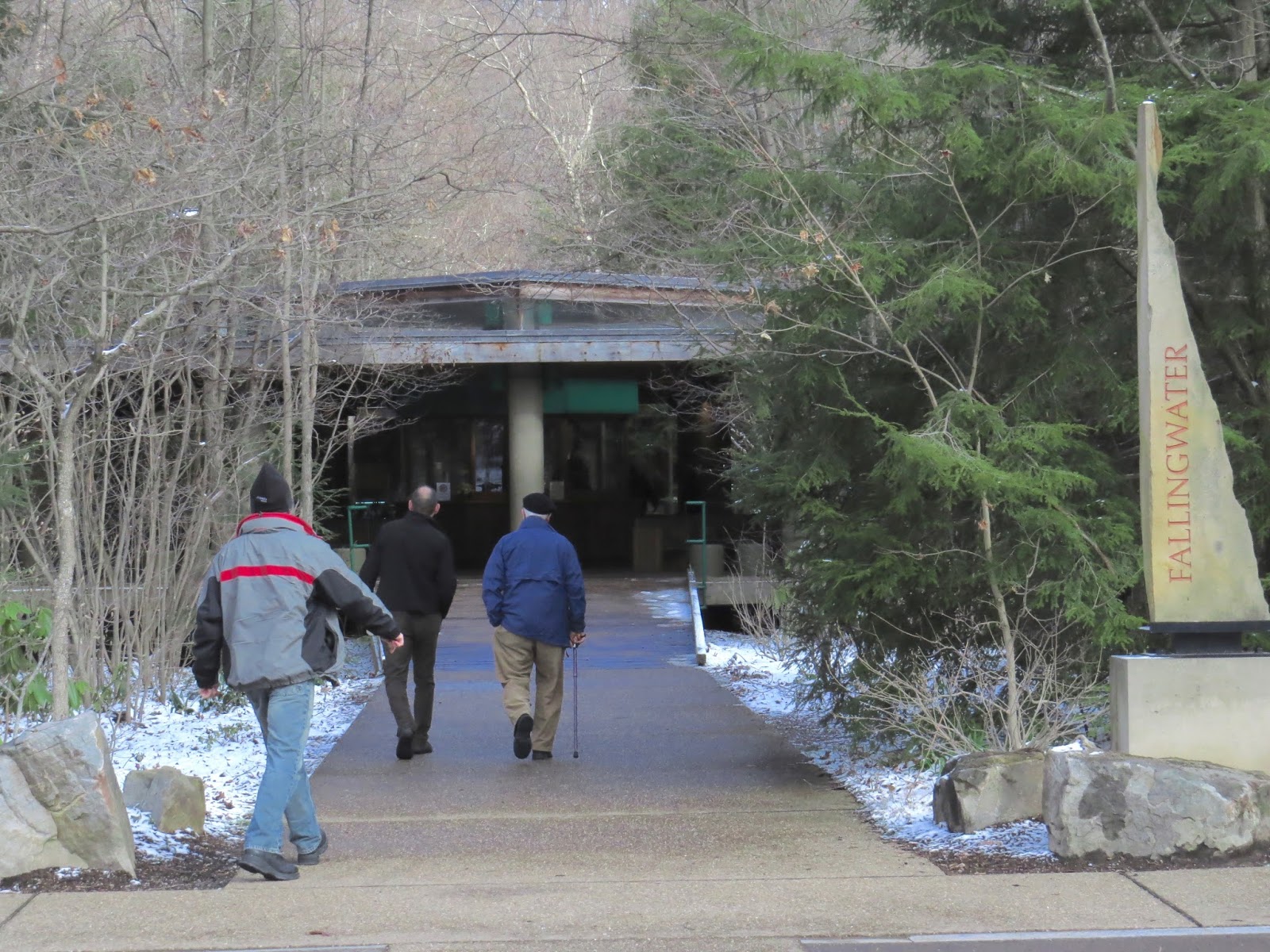 |
| Entrance off the parking lot - the central building is the ticket window |
 |
| I found the water recycling interesting and green |
 |
| View back up the trail that leads to the house |
Soon our tour number was called and we went to meet our guide and group, which mostly consisted of young Asians.
 |
| First glimpse of the house from the path |
 |
| First stop |
The tour guide collected us just before the bridge over Bear Run Creek and told us that we would not be able to take any photographs inside the house. So you will have to go there for yourself to see the fabulous interior.
This house was designed to blend and complement the area it was in and the habitat, especially the creek and waterfall, was incorporated into the house. The house is built of rocks to mimic the rocks on the ground and also in the creek bed. The floors are waxed to look like underwater rocks, while the stacked rock columns are left "dry". There are places in the house, where the natural rock outcrop rises from the floor. There is a hatch area, made of framed glass, in the living room which can be fully opened to the sight and sound of the creek. And the family could walk down the steps directly into the creek. All the bedrooms have glass walls and windows that can be opened to hear the falls.
The house interacts with those moving through it. This was especially apparent in the downstairs bedrooms where you come in from a narrow dark hall to the very bright rooms that have glass walls. The ceiling also comes way down as you come into the room, forming a very comforting level above the open wall. The colors are very simple and organic. The walls are light ochre throughout and the trim is Cherokee red. Even the built-in couches and occasional tables were designed by Frank Lloyd Wright. The kitchen, however, was not designed by him because he considered it only a work space. I think the family and their cook designed it to the cook's taste. (And by the way, the cook is the last person still alive who lived in the house - she is 102.)
 |
| Our guide gives us our first information about the house |
 |
| View of the house from the bridge |
 |
| Looking upstream from the bridge to a small waterfall |
We ended the tour in what used to be the garage for the house and which held up to eight cars. Now I think only part of the original garage is roofed and it has been converted into a movie theatre. We watched a two minute film about the house there.
 |
| The garage is high on the hill behind the house and even a little above the guest house. |
After the tour, we wandered around the grounds - and we had a lot fewer places to go than I remembered from my first visit. One of my favorite places was the front entrance which had a little pool below this spigot - some way the water from the hillside was diverted through here, then drained back into the creek. Soap on a chain was provided so people could wash their feet.
 |
| Washing spot by front door |
 |
| The house made a microclimate for this one rhododendron bush and it was the only one blooming |
 |
| The stacked stone that is use both outside and inside the house, along with a little pool and a statue - this is just before the entrance |
 |
| The reason the top floor looks smaller than the others is because it is actually the guest house and is situated uphill along a beautiful curving path. It is just designed to become part of the whole house from this view |
 |
| This is from the spot where the iconic pictures of the house and falls are taken |
 |
| The red trim is on windows - that is the Cherokee red - the corner windows open |
 |
| These steps led back to the entrance - and this is pretty much what the grounds looks like n- native trees and rhododendrons |
 |
| The sun was hitting these leaves and showing their beautiful texture |
 |
| The only blooming plants were hellebores - this area is about two weeks behind the Pittsburgh area |
I would definitely agree, that if you appreciate architecture, nature and art, you should definitely visit Fallingwater.
For a few interior pictures, click here.
On my personal front, I will have arrived at my summer refuge, Moosehorn NWR and turned 74. Looking forward to another 25 years of fun. - At least I'm demanding 25 year warranties on my surgeries.


